An internationalteam of chemists and molecular biologists has discovered a fundamentalmolecular mechanism that seems to play an important role in Alzheimer'sdisease, Parkinson's disease, mad cow disease and two-dozen other degenerativeand fatal diseases. The discovery is reported June 9 in the journal Nature, where it is featured on the cover.
Amyloid fibrils, rope-likestructures formed by linked protein molecules, are the common feature of thesediseases and may well hold important clues to these diseases, said DavidEisenberg, director of the UCLA-DOE Institute of Genomicsand Proteomics, a Howard Hughes Medical Instituteinvestigator, and a member of the research team.
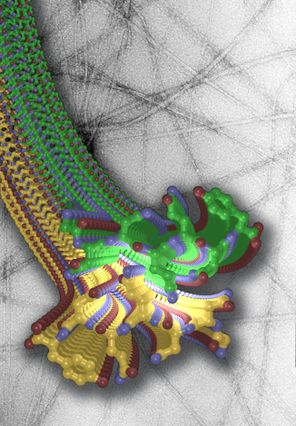
Eisenberg andhis colleagues report in Nature the three-dimensional structure of a smallpiece of a fibril-forming protein from yeast that behaves similarly to proteinsinvolved in Alzheimer's and these other diseases. Knowledge of the structure ofthis small peptide — known by the code of its amino acids, GNNQQNY — reveals asurprising "molecular zipper" that Eisenberg described as "pathologically dry."
"Proteinslive in water, but here all the water is squeezedout as the fibril is sealed and zipped up," Eisenbergsaid. "Our hypothesis is that this dry steric zipper forms in all of these diseases, and isuniversal in the fibrils. Once this steric zipper has formed, it's very difficult to reverse because it's so tight."
"Knowing thestructure may provide a rational basis for developing drugs to fight thesediseases," said Melinda Balbirnie, a UCLApostdoctoral scholar and a member of the research team.
Can scientistsprevent the steric zipper from forming in the first place, or pry it openonce it has formed?
Balbirnie is able to produce fibrils from thesmall peptide, and has developed a test, called an assay, to determine whetherthe fibrils break up.
"Her strategy isto add to this assay a wide variety of chemical compounds to see whether anywill break up the fibrils," Eisenberg said. Balbirniesaid she is "hopeful" her strategy will succeed in breaking up the fibrils.
Eisenbergand his colleagues also are investigating whether disease-forming proteins havesimilar structures. Their hypothesis is that Alzheimer's and other fatal "amyloidfibril" diseases have proteins containing the steric zipper.
"Our Naturepaper presents the first atomic-level look at any of these structures," saidRebecca Nelson, a UCLA graduate student in biochemistry and molecular biology,and member of the team that determined the precise positions of all the atomsin the peptide.
The UCLA chemists and molecularbiologists had difficulty analyzing tiny crystals from the small peptide usingstandards methods of X-ray crystallography. Nelson andcoworker Robert Grothe, formerly of the Howard HughesMedical Institute, worked indefatigably from2000 to 2004 trying to develop new methods that would work.
"We wanted tolearn which atomic-level interactions weregiving the peptide the property to form fibrils ofthe type which the body cannot break down," Nelson said. "We tried manytechniques with promising technologies that didn't work, but we never gotdiscouraged. We thought if we could better understand the structure of themolecules inside the fibrils, we would understand more about why they have theproperties they do, how they form, why they might be involved in disease andconceivably how to get rid of them or even prevent their formation."
A keybreakthrough occurred when the UCLA team began working with a distinguishedscientist in Grenoble, France, Christian Riekel, who conducts X-ray microcrystallographywith an instrument designed to analyze very small crystals.
"We sent some ofour crystals to Christian Riekel and his student,Anders Madsen, and we worked closely with them," said Michael Sawaya, a research scientist with UCLA and the HowardHughes Medical Institute, and a member of the team. "Christian invented ways toget a fine beam of X-rays to bombard tiny crystals. He and Anders were able tocollect diffraction data that allowed us to determine the structure of thepeptide, as well as a second, related peptide that also contains the steric zipper."
"So many times Ithought we were close," Nelson said, "but it didn't work until we tried thisapproach. When we solved the structure, I started dancing in the lab."
Nelson describesthe proteins associated with Alzheimer's and other amyloidfibril diseases as "transformer" proteins that instead of doing their normalwork, start forming pathological fibril structures.
"Like atransformer toy — a car that changes its shape and turns into a robot — the protein changes its shape, going from its normalfunction to a diseased state," Nelson said.
"Other proteinsjust do their jobs," Eisenberg said, "but these transformer proteins aredifferent, and exceedingly strange. We believe we are now coming to grips withthese proteins."
The researchersdiscovered that their measurements from the fibrils can all be characterized bywhat they describe as a "cross-beta diffraction pattern," Sawayasaid. "They diffract in such a way that tells us there are many extendedprotein chains stacked like a spine or the rungs of a latter," he said. "Thatpattern is a common feature in these amyloiddiseases."
Summarizing theconnections, Eisenberg said, "All of these diseases have fibrils as theircommon feature; all of these fibrils have the same characteristic X-raydiffraction pattern, which is called cross-beta; our fibrils also have thecross-beta diffraction pattern in a small section of the protein that we callthe spine. Because all of these diseased fibrils have a spine with the samediffraction pattern, and because diffraction patterns are characteristic of thearrangement of atoms, our hypothesis is thatthe two-dozen other diseases will each have a similar arrangement of atoms.
"Our hypothesisis that in all these diseases, a water-tight steric zipper hasformed in the fibrils," Eisenberg said. "Wehave seen the teeth of the zipper in two related peptides."
Theresearch was funded by the National Institutes of Health, the National ScienceFoundation and the Howard Hughes Medical Institute.
Balbirnie made the discovery that a small fragmentof a protein — a mere 1 percent of the protein — can behave similarly tothe entire protein, and is able to form fibrils. She and her colleaguesreported this surprising finding in the journal Proceedings of the NationalAcademy of Sciences in 2001.
"Like adetective, Melinda traced this fibril-forming property down to a littlepeptide," Eisenberg said. "Nobody expected that 1 percent of the proteincould have the essence of the whole protein and could form fibrils on its own;I certainly didn't expect that. There were only seven amino acids in thatfragment. Rebecca later found the peptide could be cut to only four amino acidsand form fibrils."
"No one hasknown the details of these structures before, which we can now see," Balbirnie said. "The fibrils are stable in all of thesediseases; we can account for that stability, which suggests this may be acommon feature. We are learning how these biological machines work."
-UCLA-
LSSW276