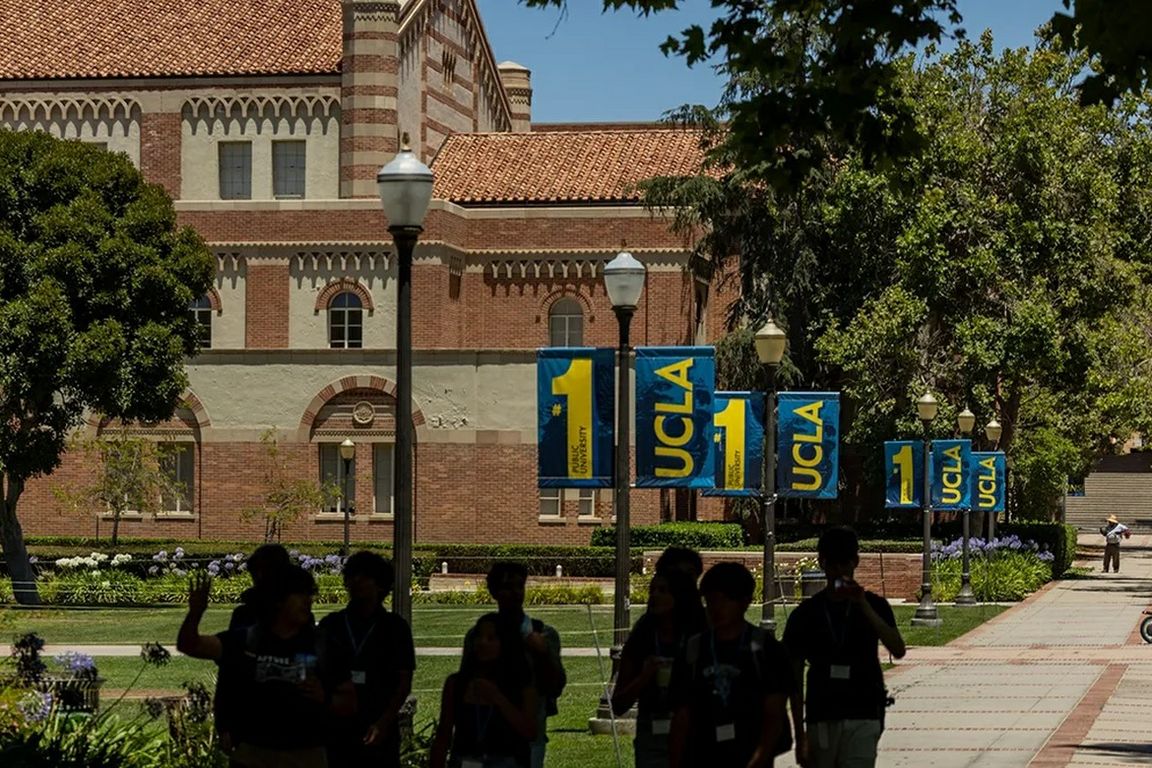
NBC News reported that UCLA was named the No. 1 public university in the country by U.S. News & World Report, tying with UC Berkeley. UCLA was recognized for its graduation rate, faculty resources, performance and several other factors. In addition to the top public university title, UCLA was also named No. 1 among public universities for veterans. Also: SFGate, New York Times, KABC-TV, KTLA-TV and LAist.) Read more about UCLA in today’s Associated Press, New York Times, Spectrum News 1 and others.
See our UCLA in the News daily archive.
More highlights from UCLA in the News: September 22, 2026
New poll shows how gender, education play role in Latino vote | Spectrum News 1
A new poll from UCLA’s Latino Policy and Politics Institute, and the UC Berkeley Institute of Governmental Studies, finds that experience, along with age, gender and education, can shape how Latino voters view some of the biggest political issues. (approx. :35 mark).
California coast could see the strongest El Niño ever | KCRW 89.9-FM’s “Press Play”
“We’re seeing a very intense El Niño. And so in effect, what that is, is we have a bunch of warm water pushed against our shores, and warm water, of course, expands, and so we’re seeing higher tides than we would normally see. And we have warm water further north, which allows tropical storms or hurricanes to come further north, and with that, larger waves to end up on our shores,” said UCLA’s Timu Gallien.
C.T.E. can’t be detected in the living. New brain research offers hope | New York Times
Working with researchers at the University of California, Los Angeles, Dr. Bailes has taken a similar tack, developing a biomarker that makes [chronic traumatic encephalopathy]’s abnormal tau visible on PET scans. A Phase 3 clinical trial is now underway to determine whether the scan is an effective diagnostic.
As computers take the driver’s seat, experts worry about safety | New York Times
“There is this irony,” said Ms. [Ann] Carlson, who is now a professor at the UCLA School of Law. “The better it gets, in some respects the more dangerous it gets, unless it’s so good that it doesn’t cause problems, which is not true at this point.”
FBI visits California MAGA stronghold after allegations of ballot stuffing | CalMatters
Sonni Waknin, an attorney at the UCLA Voting Rights Project, used her own experience to highlight how well California’s safeguards work. She said one of her ballots in a past election was flagged at a California elections office because the signature she used to register to vote didn’t appear to match the one she signed on her ballot. Elections officials reached out to her to verify it was her signature, and she was required to fill out a form to declare it was indeed Waknin who filled out her ballot.
California could save millions with switch to electric appliances | CalMatters
Californians spend billions of dollars each year to maintain an aging gas infrastructure. According to UCLA’s Emmett Institute on Climate Change & the Environment, customers will pay $43 billion by 2045 to keep this dinosaur of a system alive.
Israel can’t postpone its reckoning forever | The Atlantic
“One might have thought October 7 would have caused a substantive debate about Israel’s broadest strategy,” Dov Waxman, an expert on Israeli politics at UCLA, told me. But the election won’t be about the future of Israel, let alone its relations with its external enemies. “It’s about which parties are willing to work with which.”
ICE hides locations of detainees with final removal orders | Associated Press
Nearly 16,000 people who were arrested and booked into ICE detention in July were subject to final removal orders, more than a third of the overall bookings, according to ICE data obtained by the Deportation Data Project based at UC Berkeley and UCLA.
Health care premiums are soaring, with few alternative options | The Los Angeles Post
An analysis by the UC Berkeley Labor Center and the UCLA Center for Health Policy Research projects that by 2030, 4.6 million Californians under the age of 65 will not have health insurance, an increase of 2.2 million uninsured people, doubling the state’s current uninsured rate.