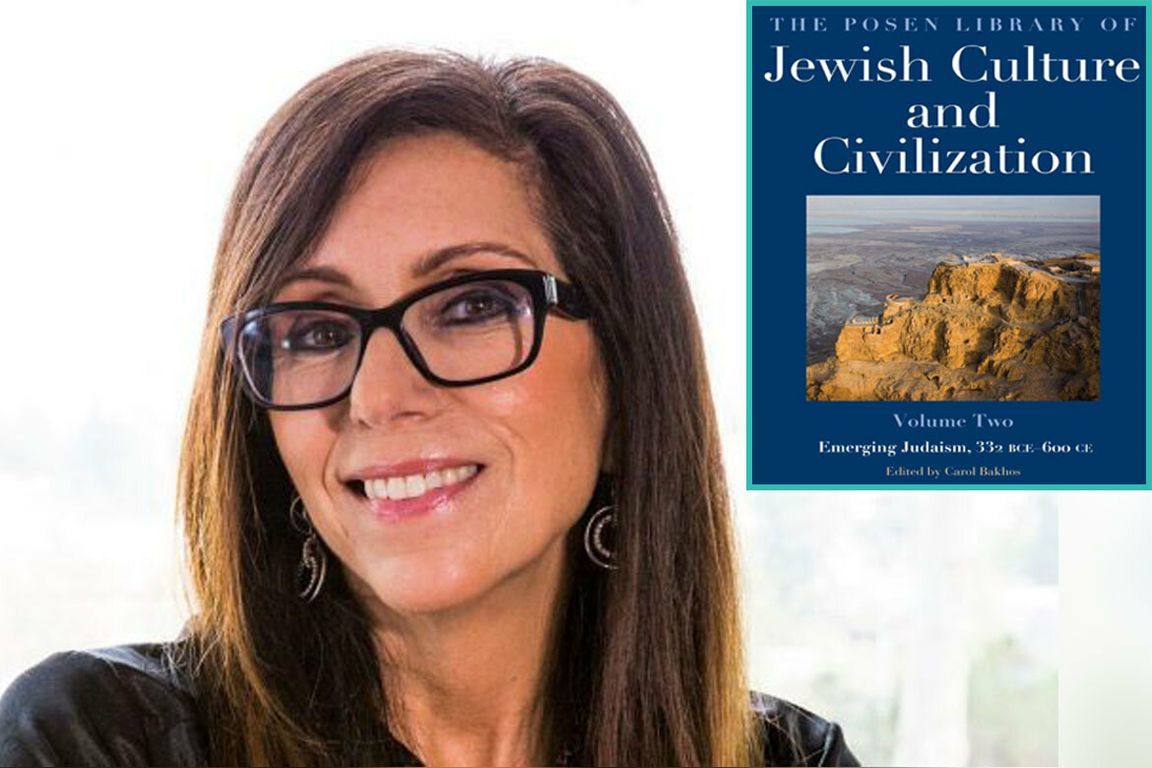
It’s easy to think of religious traditions as fixed. But according to Carol Bakhos, UCLA’s Robert E. Archer Professor of the Study of Religion, the history of Judaism tells a far more dynamic story.
Bakhos, who is also a professor of Jewish studies and director of the UCLA Center for the Study of Religion, recently received the 2026 Judaica Reference Award from the Association of Jewish Libraries for her work editing “The Posen Library of Jewish Culture and Civilization, Volume 2: Emerging Judaism, 332 B.C.E.–60 C.E.” The anthology examines a pivotal period in Jewish history when communities adapted to changing political and cultural realities and many of the practices familiar to Jews today began to take shape.
Drawing on a wide range of sources — from rabbinic texts and inscriptions to everyday objects such as “magic” bowls laden with incantations and a finely woven hairnet preserved from antiquity — the volume offers a vivid portrait of Jewish life across the ancient world. These materials reveal not only religious beliefs and practices, but also the experiences of ordinary people navigating their daily lives.
The project also reinforced a lesson, which Bakhos says resonates far beyond ancient history, and that’s that Jewish life has never been monolithic. Diversity, debate and adaptation, she says, have long been a part of the story.
Bakhos spoke with UCLA Newsroom about the rise of rabbinic Judaism, the roots of modern Jewish practice and what studying the past can reveal about the present.
This interview has been edited for length and clarity.
Your latest volume of work covers what you’ve called “the formative period” for Judaism. What are some practices, customs and beliefs that emerged in that time and have become defining elements of American Judaism today?
I think it's really important to understand that the Judaism predominantly practiced today throughout the world is a form of rabbinic Judaism, so 332 B.C.E.–600 C.E. is the formative period, because during this long span of time, a great deal changed in Jewish beliefs and practices.
Practices that took place at the temple could no longer take place [after the destruction of the Second Temple]. So, what do you do with that? The rabbis stepped into this breach, and over time created a mechanism to keep the Jewish tradition alive and speak to questions such as what it means to keep kosher; when, how, and how often to pray; how to observe the Sabbath; and what is entailed in marriage and divorce. Virtually any practice or ritual the Jews partake in today emanated in one way or another from this period. The rabbis within this great span became more authoritative, and their teachings became elevated.
But there isn’t an ecclesiastical hierarchy, similar to what we find in Christianity. The authority of the temple priesthood collapsed along with the temple. In this period, we have the democratization of Judaism, from temple to table, for example. What I mean is that the Passover that took place in the temple now takes place around the table.
One theme that comes through in your work is the diversity of Jewish belief and practice in the ancient world. How does understanding that complexity change the way we think about Jewish identity and community in America today?
We often think of the past as monolithic and homogeneous, and that is rarely, if ever, the case. Certainly not with respect to dynamic religious institutions and traditions. An appreciation of the varieties of being Jewish in the pre-modern period allows us to appreciate the diversity among American Jews, or even Jewry worldwide, not as an aberration, but in keeping with historical and cultural forces that shape life throughout history.
It is interesting when I engage students around this topic, because so often we grow up with this impression that “it was always like this” — as if it just happened. What we do is historicize and complexify and demythologize the tradition, and in doing so, one edifice that comes crashing down is that very notion that everyone was uniformly in agreement, and modernity is an expression or deviance from that uniformity and is an expression of a freedom and diversity that we didn't have earlier. But in fact that's not at all the case.
You always have countervailing tendencies and traditions that reverberate throughout. One of the volume’s strengths is that it's not ideologically or religiously tethered to presenting a homogeneous picture, but in fact a picture that is richer and more accurate of that diversity.
In your research for this book, what two things surprised you most or changed your perspective on Judaism and Jewish history?
As someone who works primarily in the in rabbinic literature and literary traditions, I was pleasantly surprised by how the view of ancient Judaism shifts when you consider the richness and texture of daily life of ancient Jews — it becomes multidimensional even if the view remains ever so dim, even as it's still a mere glimpse, given the paucity of sources we have. But when you put Jewish texts alongside or in conversation with material culture, you see a broader view of Jewish life, and it was a pleasant surprise to experience it.
When you decenter the rabbis in rabbinic literature, other Jewish voices emerge, and that also adds to the richness. Again, this isn't something that I was unaware of, but working on the volume brought this recognition to life, and it deepened my appreciation of how, on the one hand, Jews were just like their non-Jewish neighbors, and on the other, just how distinct they were. It’s what it is today. I saw that, on a more profound level, during the process of putting the volume together.