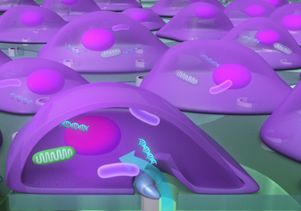
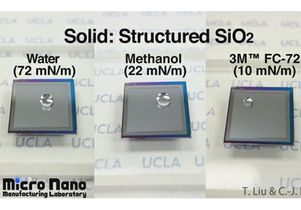
UCLA engineers and doctors developed a tool that can deliver nanoparticles, enzymes, antibodies and bacteria into cells thousands of times faster than current technology.
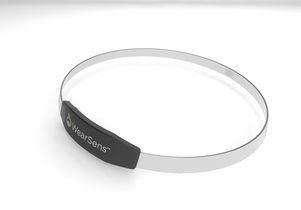
New compact, reliable energy storage devices outperform batteries by holding larger amounts of energy, recharging more quickly and lasting for longer recharge cycles.
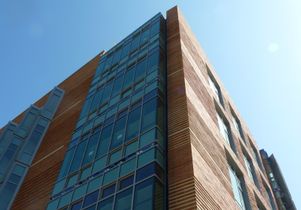
UCLA leaders and prominent alumni gathered March 19 to celebrate the new jewel of the Henry Samueli School of Engineering and Applied Science, Engineering VI.
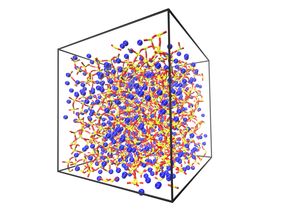
A team led by engineers from UCLA and Columbia University controlled light at tiny lengths around 500 nanometers — smaller than the light’s own wavelength — by using random crystal lattice structures.
The online master’s degree program at the UCLA Henry Samueli School of Engineering and Applied Science has been named the best in the country by U.S. News and World Report.
Padmanabhan’s support of the lab, which will be housed in the still-under-construction Engineering VI building, will further cement UCLA as a premiere research institution.
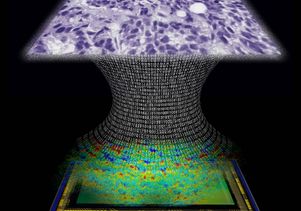
UCLA researchers led by Aydogan Ozcan have developed a lens-free microscope that can be used to detect cancer with the same accuracy as larger and more expensive optical microscopes.
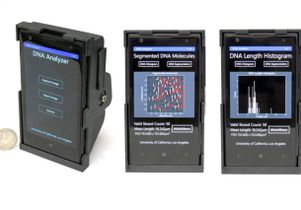
Researchers from UCLA have developed the first lightweight, compact device that converts an ordinary smartphone into an advanced fluorescence microscope.
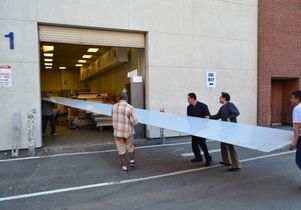
A 28-foot-long elevator from an Airbus A330 was donated to the UCLA Henry Samueli School of Engineering and Applied Science. The part, which is used for flight control on the aircraft’s tail, is valued at $750,000.
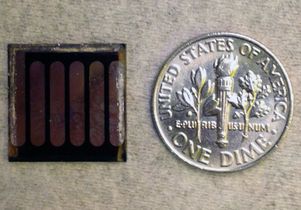
UCLA researchers find that using a perovskite solution could improve the quality and manufacturing efficiency of medical and commercial imaging devices.
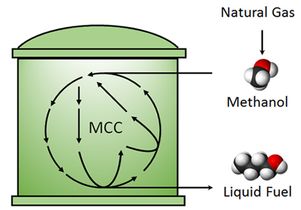
Researchers at UCLA have developed a more efficient way to turn methanol into useful chemicals, like liquid fuels, that would lower production costs in addition to reducing emission of the greenhouse gas.
Researchers from UCLA and Architected Materials will use the grant to continue developing breakthrough technology to reduce the frequency and severity of head injuries to football players.
The institute will provide new knowledge and technology to assess and manage risks in order to save lives, protect the environment and protect property from large-scale threats.
The technology, which could be used in smartphones and other wireless devices, would reduce demand on the radio spectrum without compromising quality or speed of communications.
Jacqueline and Oscar Stafsudd Jr. earned four UCLA degrees between them, and Oscar has been a faculty member for 47 years. The couple say their gift is "a way of expressing our gratitude."
UCLA will host universities and technology companies who are working to promote the development and adoption of Named Data Networking, an emerging Internet architecture.
Two UCLA engineering professors say that it's crucial for engineers to understand the hazards that threaten our levees to ensure that California's fresh water delivery system remains protected in the future.
UCLA, USC, Caltech are collaborating in creating a National Science Foundation-funded center to translate scientific and engineering research into technology for the marketplace.