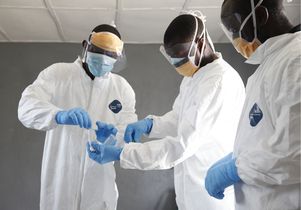
The UCLA Labor Occupational Safety and Health Program is training residents to qualify for jobs testing and handling hazardous waste materials in a multimillion-dollar cleanup of lead dust contamination.
Because the U.N. peacekeepers introduced cholera to Haiti, it’s imperative that the United Nations do whatever it can to prevent the disease from further ravaging the country.
UCLA and Inter-American Development Bank study finds progress toward universal health coverage, but persistent gaps in how citizens assess the quality and effectiveness of primary care.
UCLA researchers find that while a majority of adults do not get a flu shot each year, Koreans and Vietnamese have highest rates, African-Americans lowest.
UCLA’s Dr. Jonathan Fielding chaired panel whose report called for increased coordination both within the Department of Health and Human Services and across federal agencies.
As Americans struggle with obesity and diabetes, UC researchers say that new nutrition labels could help consumers change their shopping choices and ultimately their diets.
An innovative program that serves low-income and uninsured children in Los Angeles has more than tripled preventive dental visits for children from birth to age 5, according to a new UCLA policy brief.
Wayne Wong spent three years at UCLA studying microbiology and globalization, never suspecting that he would soon be facing issues he studied and discussed in the classroom in Uganda.
Over many years, UCLA researchers have learned that families change their behavior when they get live interactive training sessions with the familiar staff at their child’s Head Start school.
Social work professor Mark Kaplan found that an increase in high-risk drinking during the Great Recession may explain the rise in alcohol-related suicides by men — but not women.
Dr. Alice Kuo and Dr. Angelica Zen argue that gun safety is a relevant issue for children's doctors and, if discussed in appointments, could reduce the number of accidents and deaths involving children.
A new study traces how a largely unfamiliar pathogen led to a global epidemic that has linked the virus to fetal brain-development disorders and Guillain-Barre syndrome.
The initiative will train a new generation to help achieve a set of ambitious U.N.-approved goals to reduce poverty and hunger, improve health, advance education and make cities more sustainable.
More than 1 in 9 people around the world do not have access to safe, clean drinking water, and the problem is expected to worsen due in part to climate change.
Professor Roshan Bastani of the UCLA Fielding School of Public Health is the director of the UCLA Kaiser Permanente Center for Health Equity and the UCLA Center for Prevention Research.
The results presented in a new study by researchers at UCLA and in Brazil Zika revealed associations between infection and “grave outcomes” including fetal death, fetal growth restriction and nervous system damage.
The report recommends that a state agency and agricultural commissioners evaluate pesticide mixtures and implement regulations to more adequately protect human health.