In October 1969, a small group of UCLA students gathered with Professor Leonard Kleinrock in Boelter Hall to send a message between two computers for the very first time.
They began typing the word “LOGIN.”
Only two letters arrived.
“LO.”
No one in that room could have imagined how profoundly those two letters would change the world. The internet was born, and would go on to reshape how we connect with one another, share knowledge and experience daily life itself. Today, billions of people carry in their pockets technologies made possible by discoveries at universities like UCLA — phones with far greater computing power than the computers that guided Apollo 11 to the moon.
That moment in Boelter Hall reflected something essential about the role of a great public research university: the ability to pursue basic research, explore difficult questions and expand the boundaries of knowledge without knowing exactly where the journey will lead.
Some discoveries produce immediate applications. Others require years — even decades — before their full significance becomes clear. But the pursuit of knowledge itself creates the foundation upon which future breakthroughs are built.
The development of Herceptin offers a powerful example. The groundbreaking breast cancer treatment emerged from years of scientific discovery and persistence by UCLA researchers seeking to better understand the biology of cancer at its most basic level. Today, Herceptin has helped save countless lives around the world, including my wife’s, and our family knows personally the profound impact this research has had on so many patients and loved ones.
Stories like these remind us that innovation is rarely the product of a single moment. More often, it emerges through sustained inquiry, collaboration and the courage to pursue ideas whose value may not yet be fully visible.
At UCLA, that spirit of inquiry has long defined our mission. Researchers here are advancing treatments for rare pediatric diseases that may affect only small numbers of patients but hold enormous significance for families searching for hope. Scientists are conducting basic research in fields ranging from neuroscience to climate science to artificial intelligence — work that may not begin with a commercial application, but that expands human understanding and ultimately shapes the future in ways we cannot now foresee.
Universities play a unique role in society because they create the conditions for this kind of work to flourish. They bring together people from different disciplines and perspectives. They encourage curiosity. And they invest in discovery — pursuing new knowledge not because it comes with a quick cash payoff, but because it holds the potential to improve lives and even save lives.
At UCLA, innovation is not confined to laboratories or lecture halls. It is woven into our identity as a public-serving institution dedicated to advancing knowledge for the benefit of humanity. The breakthroughs that emerge from our campus reflect scientific excellence, optimism and a belief in what human creativity and collaboration can achieve.
The students and researchers who sent that first internet message in 1969 could not fully imagine the world their work would help create. Yet their willingness to pursue basic research, explore the unknown and ask ambitious questions changed history.
We are One UCLA.
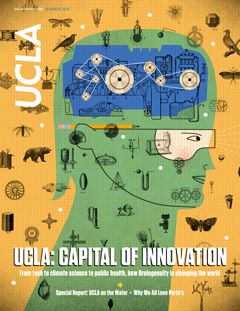
Read more from UCLA Magazine’s Summer 2026 issue.