Job growth, increased consumer confidence will fuel construction demand for commercial office space, multifamily housing projects and additional industrial warehousing space through 2017 in six major California markets.
White House immigration staff members attended a briefing Friday by UCLA students on the economic impact of the Deferred Action for Childhood Arrivals (DACA) program, which President Obama enacted by executive order in 2012 and expanded this year.
UCLA’s Bill Parent, director of the Center for Civil Society at the Luskin School of Public Affairs, writes that L.A.-area residents’ stinginess jeopardizes society’s safety net, which depends significantly on private donations.
The report foresees the U.S. economy likely growing at a 3 percent pace during the next two years, as lower oil prices and higher wages bolster consumer spending and the unemployment rate falls.
Los Angeles Mayor Eric Garcetti will escort a delegation of Los Angeles leaders to China to attend a Nov. 19 ceremony celebrating UCLA Health’s partnership with Centre Testing International on an advanced medical laboratory in Shanghai.
Year-round program aims to introduce entrepreneurship as a viable career path and foster entrepreneurial skills through individualized coaching, mentoring and business development.
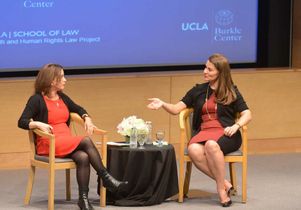
The Bill and Melinda Gates Foundation is betting big on women and girls to help developing countries lift themselves out of poverty, foundation co-chair Melinda Gates told a UCLA audience that filled Korn Convocation Hall on Nov. 5.
The world has backed away from supporting contraception in the developing world because of politics, said the co-chair of the Bill and Melinda Gates Foundation.
Charitable giving in Los Angeles County has yet to return to pre-recession levels, according to a report released Tuesday by the Center for Civil Society at the UCLA Luskin School of Public Affairs.
Retired four-star Army General Wesley Clark discussed his latest book, “Don't Wait for the Next War: A Strategy for American Growth and Global Leadership” (Public Affairs 2014) and outlined a formula for American success in the 21st century.
Two UCLA pediatricians write about the societal risks that result from working- and middle-class parents being forced to choose between paying for their children’s medical expenses and household bills.
Economist Lee Ohanian makes the case that income inequality is not nearly so rampant as reports suggest and that a better indicator of well-being is consumption.
U.S. Secretary of the Treasury Jack Lew led a wide-ranging conversation Wednesday with the UCLA Anderson’s class of 2016 that touched on such issues as world economic growth, international sanctions against Russia and stemming the flow of funds to ISIL.
A new UCLA report underscores the need for immigration reform by countering the narrative that there's been a “surge” in unaccompanied minors driven by violence in Central America.
Among the consequences of that archaic position is unfair strain on many families and the exclusion of domestic workers from labor protections, says UCLA Law professor Noah Zatz.
UCLA Anderson Professor Bhagwan Chowdhry is making the latest studies in the fields of finance and accounting more accessible and easier for the general public to understand, and he hopes that may start a trend.
The goals of the Bank of England's financial policy committee are to maintain financial stability and support the government's objectives for growth and employment. So why do we need a committee to oversee financial stability?
Researchers from the UCLA Luskin School of Public Affairs based their analysis on key factors, including what portion of renters’ income regularly goes to pay rent.
The outlook is based on the recent Allen Matkins/UCLA Anderson Forecast Commercial Real Estate Survey, which analyzes the three-year outlook for real estate development activity in California.
Similarly to countries like Denmark and Sweden, American cities and towns have been spending more on programs for the poor and the middle class, funded by higher taxes on these groups.
From 2005 to 2007, roughly 20 percent of people who committed suicide were intoxicated at death, but that percentage was notably higher during and after the recession, according to a study led by UCLA professor Mark Kaplan.
Economists Lee Ohanian of UCLA and Nobel laureate Edward Prescott of Arizona State University maintain that an important factor contributing to declining productivity growth is the large decline in the creation of new businesses.
Jack Rothman of the UCLA Luskin School of Public Affairs writes that 50 years after the passage of the Civil Rights Act black families currently own just one-tenth the assets of their white counterparts.