Q&A with UCLA professor Sarah Roberts, who has pioneered the study of the toll screening objectionable online content takes on the people who have to do it.
“Climate Lab” — a six-episode video series on climate change from Vox and the University of California — is already getting plenty of attention although it's just getting started.
The funds will support the researchers’ efforts to develop a process for capturing carbon dioxide and converting it into a material that can be used in building and construction.
Rankings by the Milken Institute put UCLA No. 1 in the nation when it comes to the number of startup companies launched as a result of campus research, no. 15 overall.
Ramesh Srinivasan, an associate professor of information studies, has studied revolutions in Egypt and Kyrgyzstan and the role of digital media in supporting indigenous communities.
The program drew from the expertise of more than two dozen speakers from film and television studios, law firms, talent agencies, new media powerhouses and venture capital companies.
Anke Audenaert, an assistant adjunct professor of marketing at UCLA’s Anderson School, never planned on working in the tech industry. But after spending more than 15 years working at various tech companies, she has charted a path to success in that field.
The device, developed by UCLA’s Aydogan Ozcan and colleagues in Sweden, could be manufactured for less than $500 each — far less expensive than the equipment that labs use for the same tests.
The key is “sequentially switched delay lines,” an approach similar to the way passenger trains are routed from one track to another, to allow them to enter and exit train stations at the same time and avoid collisions.
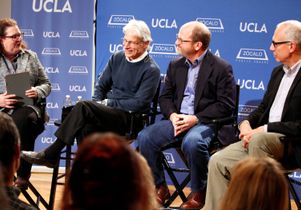
Two UCLA faculty members — molecular biologist Robert Goldberg and international law and policy scholar Edward Parson — defended the use of genetically modified organisms in food production at a Zócalo/UCLA discussion held in downtown Los Angeles.
Researchers from the schools of dentistry, medicine and engineering developed a digital health platform capable of optimizing efficacy and safety during chemotherapy.
An multidisciplinary team designed an algorithm that could discern structured narratives within the flow of posts on the internet reflecting how humans communicate.