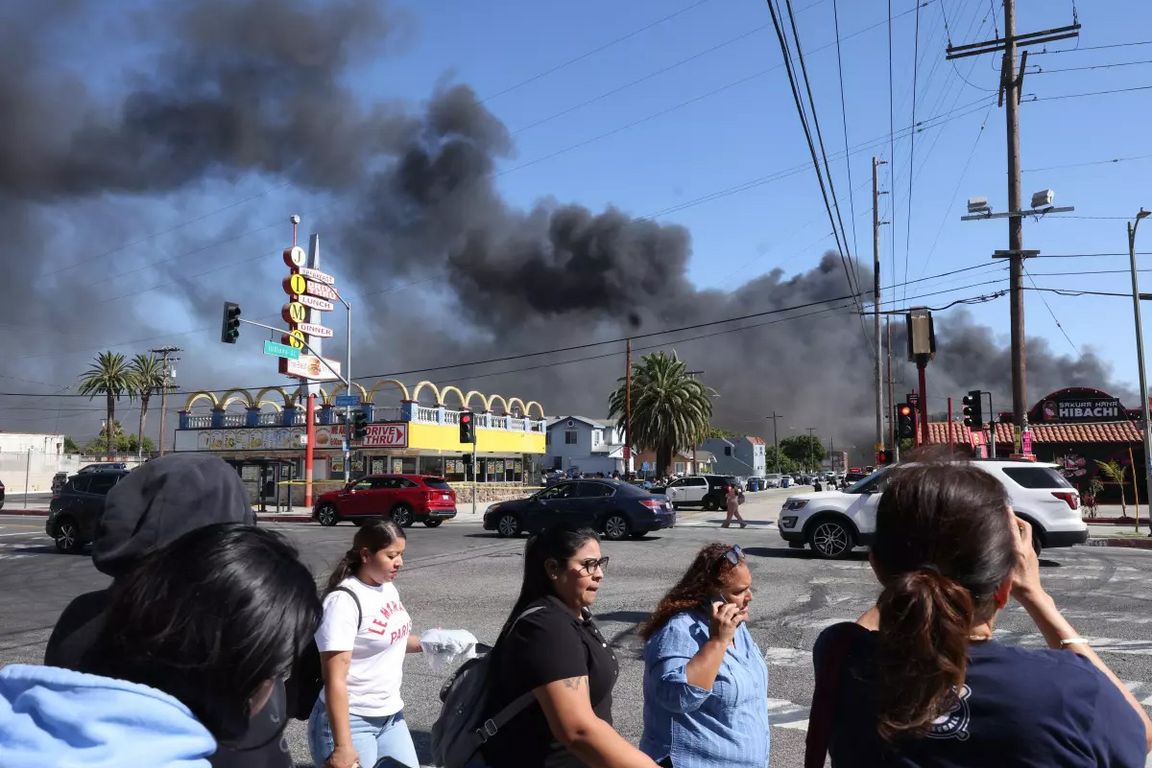
The Los Angeles Times reported on lingering questions about air quality after the Boyle Heights warehouse fire, which produced hazardous levels of fine-particle pollution and exposed gaps in monitoring for potentially toxic chemicals. Michael Jerrett, professor in UCLA Fielding’s department of environmental health sciences and holder of the Jonathan Fielding Chair in Climate Change and Public Health, said researchers know little about the health effects of the complex mix of pollutants released by such fires and called for stronger air monitoring systems to better protect nearby communities. Read more about UCLA in today’s New York Times, BBC News and others.
More highlights from UCLA in the News: July 2, 2026
250 years ago, California was already going strong | Los Angeles Times
Here’s where David Hayes-Bautista weighs in. He’s a professor of medicine and director of the Center for the Study of Latino Health and Culture at the [David Geffen School of Medicine at UCLA]. He’s also written books about early California, among them “El Cinco de Mayo” and “The Latino Big Bang in California.” As he put it, did East Coast Americans ever think “a bunch of Mexicans on the Pacific Coast have anything to do with America? Yes, we did — a lot!”
Supreme Court rules on birthright citizenship | BBC News
“Five justices of the Supreme Court made it clear that this is a constitutional ruling. And so, any law that Congress had passed would have the same result, lead to the same result as executive order. It violates the Constitution,” said UCLA’s Hiroshi Motomura.
Regular users of fentanyl are developing alarmingly strong tolerance | New York Times
In a summary of the findings, Morgan Godvin, one of the lead authors of the study and a health services researcher at the University of California, Los Angeles, said that a seasoned user’s daily street dose of fentanyl was roughly equivalent to 1,250 hospital doses of 100 micrograms of fentanyl given during and after surgery. (UCLA’s Chelsea Shover was also quoted.)
Forest firefighters can now wear breathing masks for some work | Los Angeles Times
Research has linked wildfire smoke to a range of long-term health issues, including respiratory problems, cardiovascular diseases and cancers. “The fire service knows that,” said Rachael Jones, professor and chair of environmental health sciences at UCLA’s Fielding School of Public Health. “They all have stories” of lung damage or cancer, either their own or their coworkers’.
It’s too hot to cook. But food truck workers have no choice | New York Times
Bharat Jayram Venkat, the director of the [UCLA Heat Lab] said that his team studied ambient temperatures in food trucks in that city and found that the metal structures take on outside heat throughout the day, while also producing heat in small spaces. Many trucks did not have air-conditioning, Venkat said, and if they did, it was sometimes ineffective at cooling down the space.
Garden Grove incident a warning for those near plastics factories | CalMatters
(Commentary by UCLA’s Veronica Herrera) The UCLA Luskin Center for Innovation has been studying the plastics supply chain and its impact on the public health of California communities. We have identified more than 800 plastic manufacturing facilities that use or emit hazardous and toxic chemicals in the state.
Open date for LAX ‘People Mover’ keeps rolling forward | KCRW 89.9-FM
The $3.3 billion project will eventually connect airport terminals to LA Metro trains and a new transportation center. But following its 2019 groundbreaking, SkyLink has faced roadblock after roadblock. Once it finally opens, says UCLA’s Jacob Wasserman, don’t expect an instant end to LAX’s chronic traffic jams. (Wasserman was interviewed.)
A hard-fought housing bill is now in effect | KCRW 89.9-FM’s “Press Play”
SB 79, a state bill allowing density near transit stops in single-family neighborhoods, is now in effect, though Los Angeles and other cities are allowed to slowly phase in its implementation. More than fifty areas were upzoned — less than a third of the sites that will be upzoned in LA in 2030. But don’t expect a construction blitz anytime soon, says Dana Cuff, a UCLA architecture professor and director of the university’s CityLAB think tank. Red tape and high construction costs still mean it’s really difficult to build in Los Angeles.
The story of how LA cleaned up its notorious smog | Spectrum News 1
“Inside the Issues” host Amrit Singh is joined by Ann Carlson, UCLA Professor of Environmental Law, to discuss her new book “Smog and Sunshine: The Surprising Story of How Los Angeles Cleaned Up Its Air.”
The measures on (and off) your November ballot | LAist’s “AirTalk”
“I think there are two separate things. On the issue of police oversight, why this wasn’t brought to the attention of the City Council earlier on, that this might be a meet and confer, that is a negotiable item with the police union, is beyond me,” said UCLA’s Zev Yaroslavsky (approx. 2:25 mark).
Would clearing Skid Row’s encampments change crime rates? | LAist and The LA Local
Rosenprinz said that cleanup was done through CARE/CARE+. The program, run by the city’s Sanitation and Environment Department, is intended to clear encampments and connect unhoused residents to services. A 2026 study from UCLA’s Luskin Institute on Inequality and Democracy found it “mainly [serves] to displace those people rather than to offer them services.”