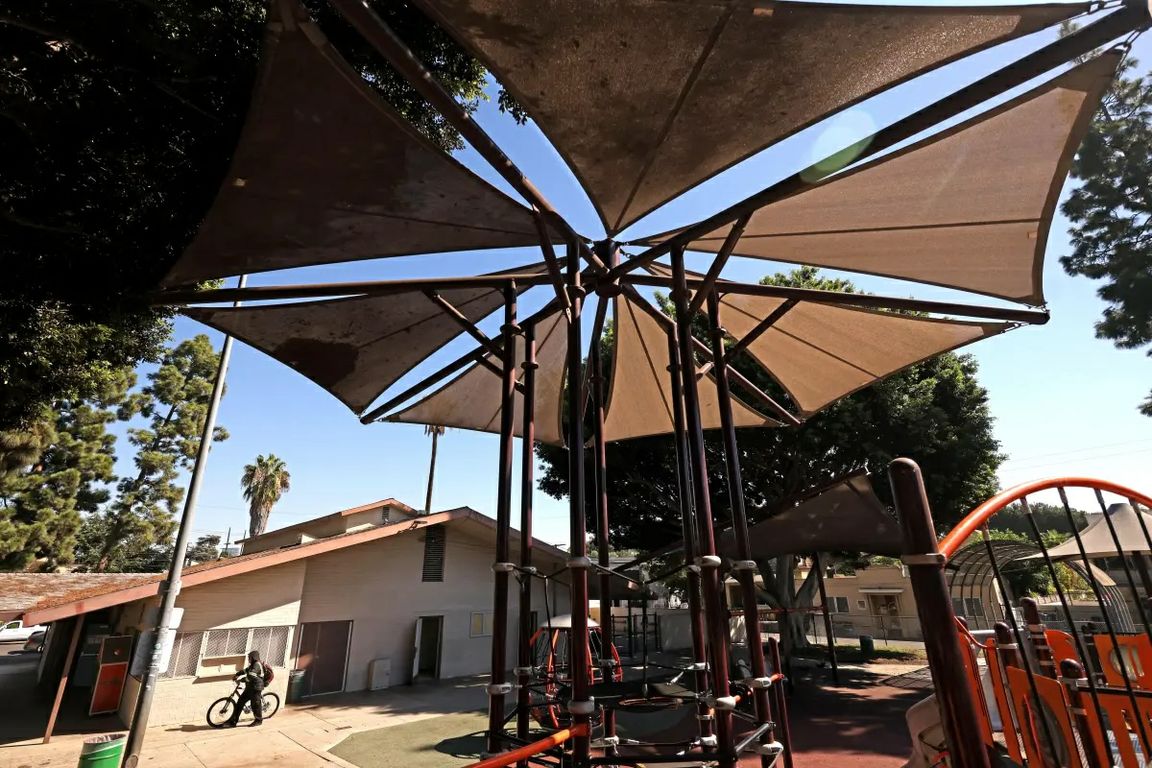
With Los Angeles sweltering through a record-breaking October heat wave, the Los Angeles Times reported on a UCLA-led initiative looking for ways to give Angelenos relief from the sun. ShadeLA, a collaboration led by UCLA and USC, is testing temporary shade sails, canopies and tents to cool public spaces where trees are scarce or take years to grow. UCLA researcher Edith de Guzman says the goal is to complement tree planting with solutions that can provide shade almost immediately. Read more about UCLA in the New York Times, CNN and other outlets.
See our UCLA in the News daily archive.
More highlights from UCLA in the News: October 8, 2026
At 194, Jonathan the giant tortoise knows about aging | New York Times
On Wednesday, he reached another milestone when a study announced that his genome had been sequenced for the first time. “We almost never get to study an animal this old while it is still alive,” said Steve Horvath, a biologist who studies aging at the University of California, Los Angeles, and an author of the study, which was published in the journal Science Advances.
A giant meteorite sits in the California desert, but you can’t look | SFGate
John Wasson, a geochemistry professor at UCLA … weighed in that “it was surely not the intention of the Congress [in passing the Antiquities Act] that all meteorites found on government lands should be exhibited ... in Washington rather than exhibited in the other fine public institutions of this country.”
The long-term trauma of wildfire survivors | Bay Area News Group
A year after the fire, [Dr. David] Eisenman and other UCLA doctors talked about a registry the university established to study the short- and long-term mental and physical effects of the fires on Los Angeles-area residents. As of earlier this year, more than 4,400 people were participating in studies, and doctors found that residents continued to deal with wildfire-related trauma. “People most closely affected — such as those who lost their houses or belongings — often experience the greatest impact,” said Emanuel Maidenberg, clinical professor of psychiatry and biobehavioral sciences at the David Geffen School of Medicine said.
Measles outbreak in Pennsylvania grows | CNN
“We were not having cases of measles very regularly in the United States. Now we have thousands of cases right here. And it's because it's such a contagious virus. You don't need to have close contact. You just need to share air,” said UCLA’s Anne Rimoin.