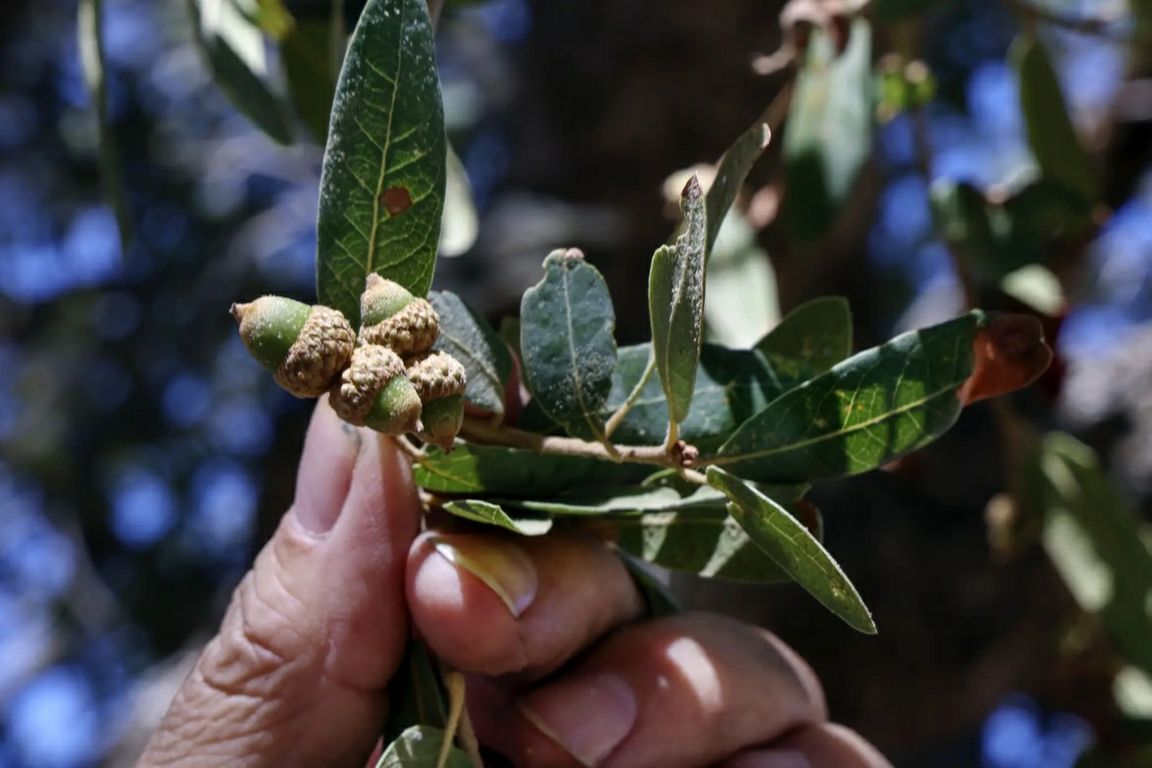
The Los Angeles Times covered efforts to restore California’s disappearing oak canopy, including a partnership that utilizes research by Victoria Sork, director of the UCLA Mildred E. Mathias Botanical Garden and a distinguished professor of ecology and evolutionary biology. Sork’s lab is sequencing oak DNA to identify trees best equipped to survive a hotter, drier climate. The goal: to use their acorns to grow a more resilient generation of oaks. Read more about UCLA in today’s Smithsonian magazine, CBS News and others.
See our UCLA in the News daily archive.
More highlights from UCLA in the News: September 21, 2026
T. rex was a warm-blooded dinosaur, UCLA study suggests | Smithsonian magazine
Now, scientists have revealed the first precise body temperature measurement for one of the world’s most iconic dinosaurs: Tyrannosaurus rex. The fearsome predator ran at a toasty 97 degrees Fahrenheit, around the same temperature as modern-day humans, according to a study published September 16 in the journal Science Advances. The findings further suggest that the beast was indeed warm-blooded, allowing experts to infer a host of information regarding the long-extinct creature. (UCLA’s Aradhna Tripati and Robert Eagle were quoted. Also: ScienceDaily.)
Is AI a threat? | MS Now
“I think that one of the challenges here is that the kind of AI doomerism that we’re hearing about, the kind of extinction event that might come from AI, is much further out than the more immediate kinds of concerns we should have about how AI is changing our society,” said UCLA’s Safiya Noble (approx. 1:00 mark).
Gov. Newsom signs joins calls for AI regulation | KABC-TV
“It’s a way to try to stop AI systems when maybe they are taking on their own emergence, what are called ‘recursive behaviors,’” said UCLA’s Ramesh Srinivasan (approx. 1:30 mark).
Trump administration revamps century-old immigration restriction | MS Now
“We have lots of historical evidence about how this could be used. So, this is implemented in 1882, as you have already discussed. At the same moment that you have the rise of Chinese exclusion and efforts to keep unwanted immigrants out of this country. Unwanted, often being coded racial term, keeping impoverished people out of the country,” said UCLA’s Kelly Lytle Hernández.
Increased ICE enforcement in 2025 hurt local employment, analysis finds | CBS News
Another 2026 analysis, by the UCLA Latino Policy and Politics Institute, found that customer visits to businesses in Los Angeles County fell by as much as 11% in the weeks following ICE enforcement operations in the region.
These Latinas are 30 points tougher on Trump than Latino men their age | Latin Times
California’s registered Latina voters rate protecting immigrant communities, pushing back against President Trump’s agenda, and defending democracy as far more urgent priorities than Latino men do, according to a new joint analysis from UCLA’s Latino Policy and Politics Institute and UC Berkeley’s Institute of Governmental Studies. (UCLA’s Nicholas Vargas and Guadalupe Garcia Lopez were cited.)
Newsom signs bills meant to prevent interference in midterms | New York Times
Rick Hasen, an election law professor at the University of California, Los Angeles, said he was skeptical that California would be successful in stopping officials from the U.S. Department of Justice if they tried to collect ballots during an election, a scenario that has not occurred in modern times.
Despite court wins, California election war with Trump rages on | Los Angeles Times
Rick Hasen, director of the Safeguarding Democracy Project at UCLA Law, said he is concerned the Trump administration will try to deny the outcome or seize ballots in close congressional races — but only if control of the House or Senate rests on them.
Humans and animals are learning to live together in an expanding LA | The Guardian
“Black bears are incredibly adaptable, versatile omnivores,” said Wilson Sherman, a doctoral student at the University of California, Los Angeles, who studies human-wildlife interaction. “They can eat everything we can eat.” (Sherman was also interviewed on KCRA.)
LA providers say federal funding delays ‘wreaking havoc’ in homeless services | LAist
Scott Cummings, a professor of legal ethics at the UCLA School of Law, told LAist it’s not unusual to seek a stay after an order like Carter’s. But litigation takes time, and the programs are effectively put on hold while it’s worked out in court. “There are short-term wins for the [Trump] administration in just playing this delay game,” Cummings said. “The delay can actually last a long time, and in the meantime, the programs are suffering, and the people they’re serving are suffering.”
Disbarred Eastman continues working on case | Bloomberg Government
But the appearance is still of “huge concern,” said Scott Cummings, a legal ethics professor at the UCLA School of Law. Many courts across the country have admissions processes premised on having good standing with the bars of other jurisdictions and have rules about reciprocal discipline. “I’m not sure what Eastman’s argument is for still being able to qualify,” Cummings said.
Rideshare drivers want a fair hearing before losing their jobs | Capital & Main
Tia Koonse, policy director at the UCLA Labor Center, said the new laws establishing an appeals process for drivers facing deactivation are critical at a time when some drivers are organizing for union representation and therefore might face retaliation. Making an example of one driver might be enough to chill organizing, she said. “You do it to one driver, and then everybody else knows what could happen, and they don’t organize anymore,” she said.
What a massive new crater means for future moon bases | New York Times
During an impact event, “the ejecta blanket will be made up of a range of sizes of rocks that in turn make their own craters,” said Elisha Jhoti, a doctoral student at the University of California, Los Angeles, and an author of one of the two new papers. But how far can that debris travel?
The wildfire danger we’re only just beginning to understand | Vox
That said, researchers at UCLA have been keeping a close eye on background toxic chemicals in the aftermath of the LA fires. In a paper published in June, they identified high levels of chromium 6, a carcinogenic metal nanoparticle that can cross cell membranes easily, in wildfire cleanup zones for up to two months following the actual fire. Abnormal concentrations of these heavy metals were also found up to six to nine miles downwind from the zones themselves.
Readers share their real-world EV experience | Los Angeles Times
People in LA’s lower-income communities have a harder time accessing EV chargers, according to a 2025 UCLA study. “EV chargers aren’t just missing in disadvantaged communities — they’re also more likely to be broken. That’s a double barrier for people who can’t charge at home,” said Dr. Yifang Zhu, one of the study’s researchers.
In fighting for every Black child, did I betray my own? | The New York Times Magazine
As the UCLA Civil Rights Project describes it, New York “is a four-race city where white and Asian students, on average, attend middle-class, predominantly white and Asian schools and Black and Latino students are increasingly going to school with each other in schools where poverty is the norm.”
Kim Kardashian’s new health scare: What is esophagitis? | NBC News
In 2019, the Kardashian family helped open the Robert G. Kardashian Center for Esophageal Health at UCLA, established as “a center for holistic, patient-centered treatment, research and education related to disorders of the esophagus,” according to a news release. The family said at the time that it planned to launch fundraising efforts to support the center’s key initiatives.