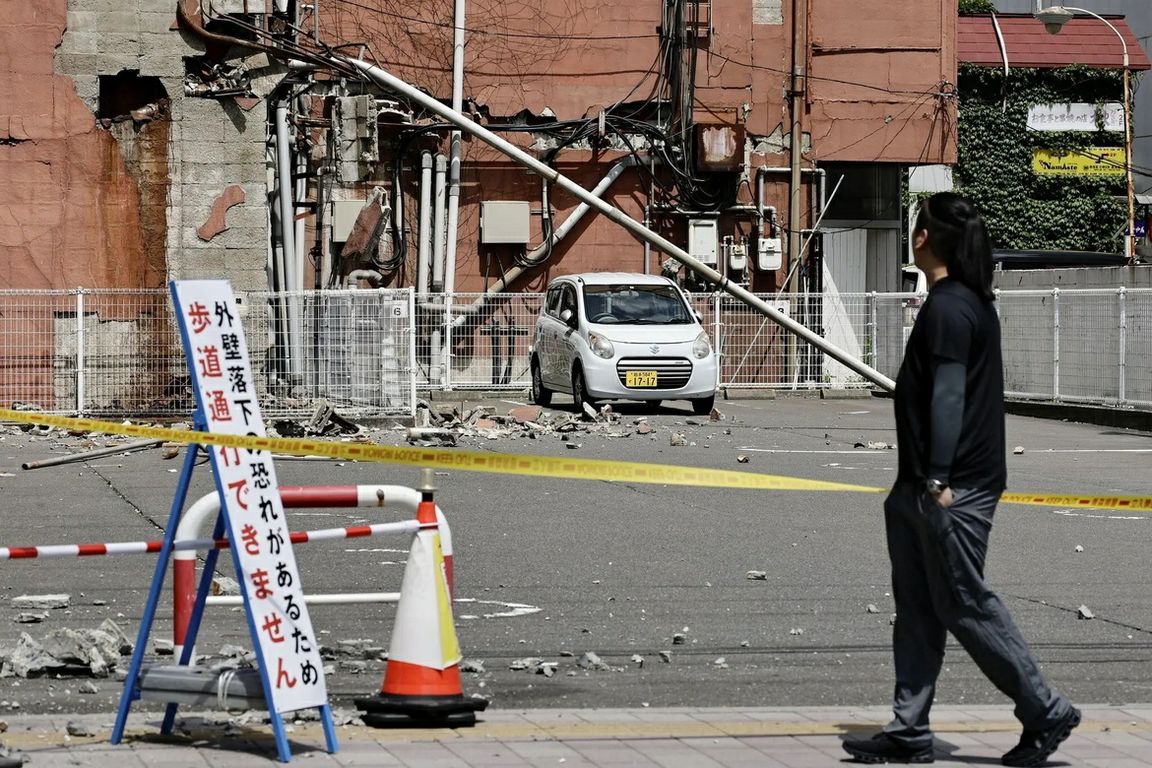
The New York Times reported on what experts are saying about a series of earthquakes that struck three seismically active regions — Japan, Northern California and Venezuela — within 24 hours. Neither earthquake in Japan nor California was close enough to transfer stress to the tectonic plates under Venezuela, said Martin Hudson, an expert in geotechnical engineering at UCLA. But the strength of the first Venezuelan quake could have triggered the second in the region. “The shaking of the first earthquake increases the stress on a nearby fault,” he said. “If the other one was close to going off anyway, it wouldn’t take much to set it off.” Read more about UCLA in today’s The Conversation, KCRW’s “Press Play” and others.
More highlights from UCLA in the News: June 25, 2026
LAFD hopes to extinguish warehouse fire soon | KNBC-TV
“With very large-scale industrial fires, we know anything like that burns, combustion generates a whole suite of toxic compounds that get released into the into air,” said UCLA’s Yifang Zhu (approx. 1:10 mark. Also: Zhu and UCLA’s Yoshira “Yoshi” Ornelas Van Horne were quoted by the Boyle Heights Beat.)
LAPD officer shoots and kills dog | KCRW 89.9-FM’s “Press Play”
“In the moments you’ve just played, I think there’s a fair bit to learn or consider about what the department has done. This was a welfare check. There was no indication that anyone was at risk,” said UCLA’s Joanna Schwartz (approx. :55 mark).
Are algorithms unfairly screening out immigrant job applications? | The Conversation
Similarly, Safiya Noble, a professor of gender studies and African American studies at the University of California, Los Angeles, has shown how seemingly neutral digital systems can reproduce broader social inequalities in her book, “Algorithms of Oppression: How Search Engines Reinforce Racism.”