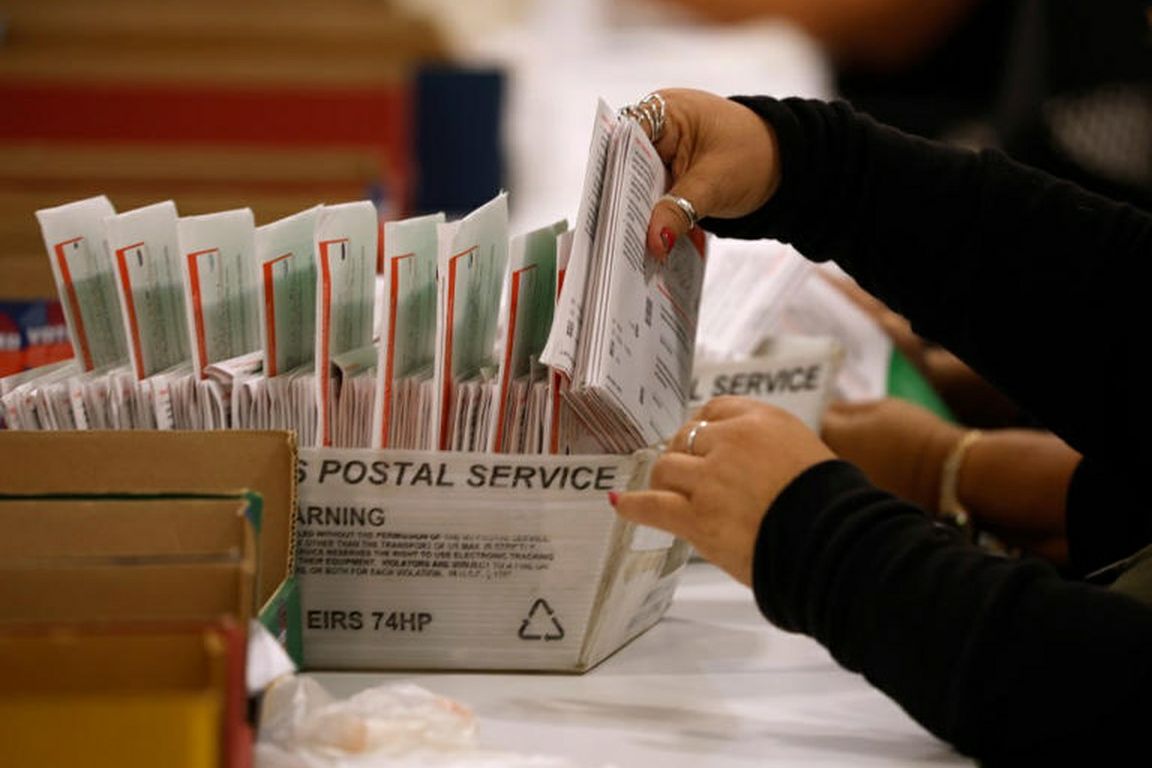
Newsweek interviewed Rick Hasen, director of the Safeguarding Democracy Project at UCLA School of Law, in an article on the Trump administration’s request that the Supreme Court allow new Postal Service restrictions on mail-in ballots to take effect ahead of the November midterm elections. Hasen has argued that the president does not have the authority to reshape mail-in voting by executive order. (Hasen was also featured by NPR’s “Morning Edition” and The Washington Post.) Read more about UCLA in today’s New York Times, KQED-FM and other outlets.
See our UCLA in the News daily archive.
More highlights from UCLA in the News: September 8, 2026
Combating Islamophobia, antisemitism is a shared responsibility | Los Angeles Times
(Commentary written by UCLA’s David Myers) One of the main features of political life today is a complete lack of inhibition in saying what you think. Sometimes this disinhibition is just part of the smash-mouth, WWE-style culture that is omnipresent in traditional and newer social media platforms — crass but signifying very little. And sometimes it betrays deep currents of hate and prejudice.
Initial count of unsheltered people by LA County “obviously low” | KQED-FM
The new report from academics at USC and UCLA indicates that potentially close to 6,000 people could be displaced. That figure is more than three times higher than an estimate the Los Angeles County Department of Housing and Homelessness gave LAist earlier this year. “That just seemed obviously low,” said Randall Kuhn, a UCLA professor and demographer who co-runs a monthly survey of unhoused people in Los Angeles. In total, there are around 49,000 unsheltered people countywide, according to the 2026 point-in-time homeless count.
DOT loans LA Metro $802.5M — but it’s not for transit | Spectrum News 1
Jacob Wasserman, who oversees public transit research at UCLA, said he sees both sides of the investment. “I’m of two minds on it,” he said. “On the one hand, express lanes do work well.” Wasserman added that express lanes can move large numbers of people more efficiently because traffic is kept moving, which can also benefit buses traveling in those lanes.
Scientists map key protein interactions linked with profound autism | NPR
“It’s an unprecedented resource for the field,” says Dr. Daniel Geschwind, a professor of human genetics, neurology and psychiatry at UCLA who was not involved with the study. “A lot of people interested in understanding autism and drug development are going to be using this.”
Angelenos who make $93,300 may qualify for housing assistance | Spectrum News 1
Shane Phillips, housing initiative manager at the UCLA Lewis Center for Regional Policy Studies, explained that housing costs place the heaviest burden on people in California. “If you look at the pace at which Los Angeles city, Los Angeles County has built housing over the past 20 years or so, and it is much, much slower than many other cities across the country,” Phillips said.
Water agencies may get a new defense in lawsuits over wildfires | Los Angeles Times
UCLA researchers recently have studied various options for state oversight of water agencies’ role in wildfires. “I don’t think it should or will be the final word, but it’s a step in the right direction,” said Greg Pierce, director of the UCLA Water Resources Group.
Google told drivers to drive a longer way on purpose | SFGate
The Google study’s findings confirm what other researchers have long suspected, said Michael Manville, a professor of urban planning at UCLA who was not involved in the study. “This is a pretty nice empirical illustration of a longstanding idea,” he said. If a clogged traffic artery is on the verge of a long delay, he said, rerouting a small number of vehicles away from the bottleneck produces a “not gigantic but noticeable result.”
One man’s journey through the new era of lung cancer care | NPR’s “Weekend Edition”
Lung cancer comes in many genetic forms and is historically hard to treat. But UCLA oncologist Jonathan Goldman says researchers are now developing more drugs that target malignancies based on their genetic profile. “Survival used to be under a year. And now it’s often several years and sometimes many years,” [said Goldman.]
Extreme heat is worsening other climate impacts on health | Dialogue Earth
The effect was more pronounced in certain neighborhoods, says study author Miriam Marlier, who works on the overlap of environmental change and public health at UCLA Fielding School of Public Health in the U.S. The at-risk neighborhoods had factors that are all too familiar to those who study urban heat: “[Lower levels of] local tree canopy coverage, local income and health insurance coverage were related to higher synergistic effects,” she says.
Addressing chronic absenteeism among homeless students | Los Angeles Times
Statewide data show that students experiencing homelessness have among the highest rates of chronic absenteeism at about 35%, far above the state figure of 19%. At the same time, the number of homeless students in Los Angeles County has surged 28% in recent years — from 47,689 in the 2022-23 school year to 61,249 in 2023-24 — according to studies from the UCLA Center for the Transformation of Schools.
The summer when TV started to portray female friendship accurately | New York Times
Yalda T. Uhls, a psychologist and researcher at UCLA and former executive at movie studios like MGM and Sony, researches Gen Z attitudes about sex and romance in TV and movies. Since 2023 she has released an annual report, “Teens & Screens,” that explores what themes and stories young adults want to see reflected in TV, movies and social media.
Civil rights, Black feminism shaped Steinem’s revolution | NPR’s “Weekend Edition”
“Gloria was an ally, a colleague and worked closely with all of these women in all of these different phases of the movement. She was more connected with the ground-up vision of feminism than the suburban-housewife-out vision,” [said UCLA’s Kimberlé Williams Crenshaw.]
Marmots are having a moment and I’m here for it | Outside
My newfound marmot interest left me with more questions than answers. So, I recently sought some info from the global expert on the critters: Professor Daniel Blumstein of the Department of Ecology and Evolutionary Biology at the University of California, Los Angeles. Blumstein also oversees the Marmot Project at the [Rocky Mountain Biological Laboratory] and spends his summers studying the cuddly critters near Gothic, Colorado. Here are some takeaways I got from our correspondence.
How many local smoke shops are selling addictive, illegal products? | Sacramento Bee
(Commentary co-written by UCLA student Youlin Zhu) We are young adults living in Sacramento who have lost friends and loved ones to drug addiction. We are both aspiring medical students hoping to advance public health and health equity in our community. This summer, through an internship at Youth Forward, a local non-profit, we researched the accessibility of addictive, dangerous products in smoke and vape shops in the City of Sacramento that are banned in California.
All on-street parking should be free, says mayoral candidate | CBC News
Michael Manville, professor of urban planning at the UCLA Luskin School of Public Affairs and co-director of the UCLA Center on Parking Policy, agrees. He said it’s unlikely that Lawson’s idea would actually help local business. “Charging for parking is a way to manage that space and it’s very unlikely that a local business would benefit from completely unmanaged street spaces,” he said.