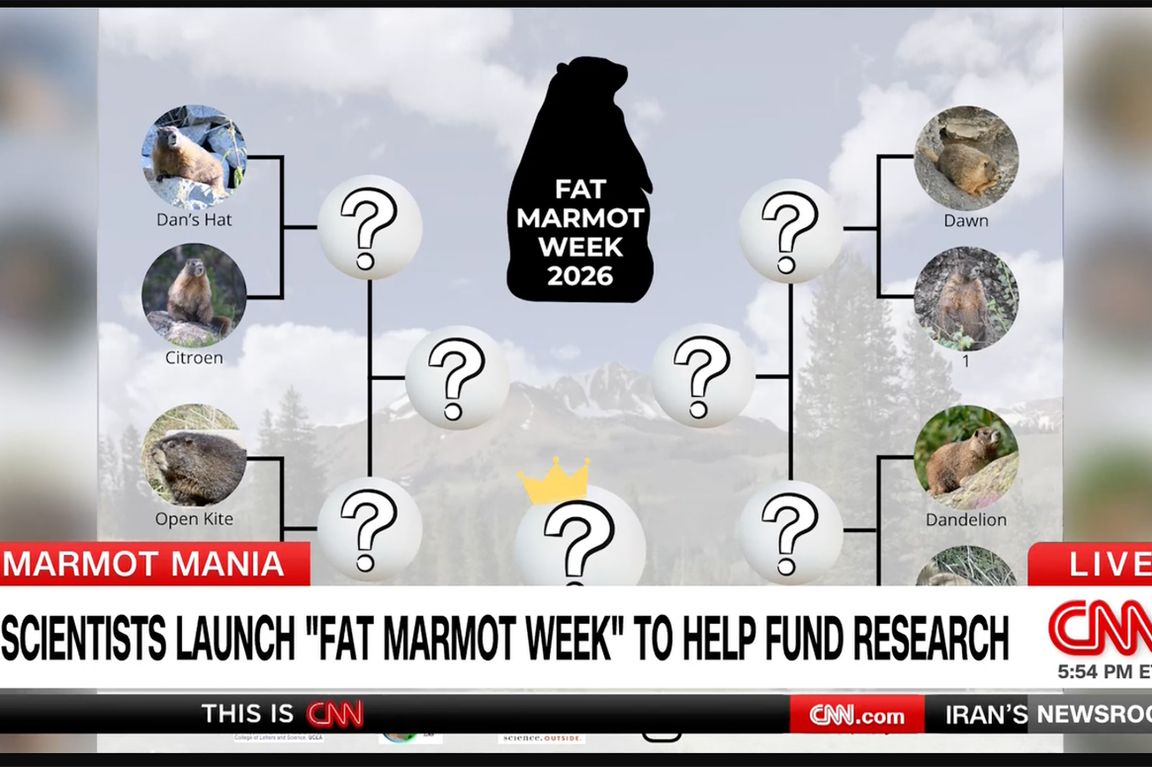
During a segment about Fat Marmot Week — a fun challenge that invites everyone to learn more about marmots — CNN spoke to Dan Blumstein, UCLA professor of ecology and evolutionary biology, about why long-term research, such as the Rocky Mountain Biological Laboratory Marmot Project, is important. “This is the second-longest study of individually marked mammals in the world, second only to the Jane Goodall study of chimpanzees,” Blumstein said. “Long-term studies give us the ability to understand how organisms, whether they're plants or animals, respond to environmental change.” (Also: LAist and KTLA-TV.) Read more about UCLA in today's Los Angeles Times, NPR and Bloomberg Law.
See our UCLA in the News daily archive.
More highlights from UCLA in the News: August 24, 2026
A battle over 'Italian brainrot' could shape who owns AI art | NPR
"We're still in the middle of figuring out, as a copyright matter, how much human involvement there has to be" for AI art to be legally protected, said Mark McKenna, a law professor at the University of California, Los Angeles who co-directs the university's Institute for Technology, Law and Policy. McKenna thinks the day will come when an AI drawing, story or song is copyrighted, but he said, "I don't have some specific prediction of how many prompts it's going to take."
Latinos are turning to social media for health info | Los Angeles Times’ “De Los”
“It’s an interesting finding, but not surprising,” said Arturo Vargas Bustamante, a professor of health policy and management at UCLA and the director of faculty research at the Latino Policy and Politics Institute. “Latinos are among the demographic groups that are less engaged with the healthcare system in the U.S.”
Want to live longer? Try standing on one foot while reading this | Los Angeles Times
The reason that balance is so important, says UCLA Health sports medicine physician Kimberly M. Burbank, is because “it’s a real-time assessment of how well our systems are working together — our brain, nerves and muscles. That’s why it’s one of the strongest functional predictors of health, including healthy aging. It requires a ton of coordination and different brain processing centers to be well balanced.”
How to make sure you don’t outlive your money | Fast Company
Hal Hershfield, a social psychologist at UCLA, found that when people think about themselves 10, 20 or 30 years in the future, their brains respond as if they are thinking about a stranger. Unfortunately, it’s very difficult to feel concerned about a future self who feels unrelated to you.
California justices race to weigh ballot fight before midterms | Bloomberg Law
Chad Dunn of UCLA’s Voting Rights Project, which represents the suing voters, said the pending ruling could send a clear message to any national “copycat characters” watching these cases who seek to intervene in elections. Dunn said he’d like to see the high court issue its opinion ahead of early voting and when mail-in ballots are sent out for the upcoming midterm elections in November.
Why classic stock-picking rules no longer work | Barron’s
The returns today from betting on most of the publicly-known stock signals have shrunk to a small fraction of a percent, says Ivo Welch, a finance professor at the University of California, Los Angeles’ Anderson Graduate School of Management.
Commerce councilmember seeking fourth term in a city with 3-term limit | Pasadena Star-News
Rick Hasen, director of the Safeguarding Democracy Project at UCLA School of Law, said the arguments seem “to go against both the language of the revised ballot measure as well as the intent of the voters.” However, the legal battle playing out now is the appropriate challenge when there is a question about a candidate’s eligibility, he said.
UN: Ebola spreading exponentially in the DR Congo | BBC News
“Right now, we are really seeing Ebola just continue to take off. This is because we started behind this virus, and we’ve been chasing behind it ever since,” said UCLA’s Anne Rimoin.