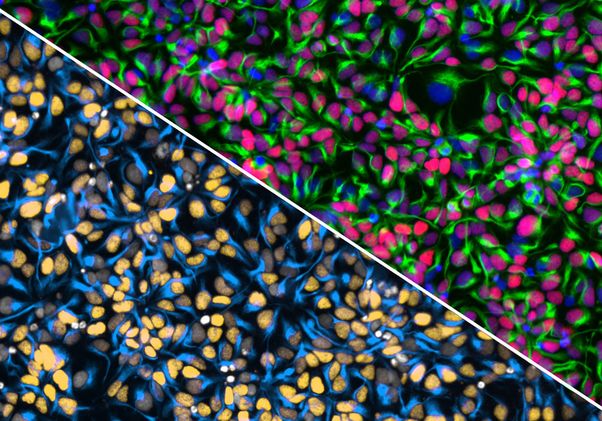
Science Friday interviewed UCLA’s Andrea Ghez about the game-changing discovery that led her to receive a Nobel Prize for her observations of a supermassive compact object at the center of the Milky Way galaxy. Ghez, who was a 2020 Nobel Prize winner in physics, developed techniques that allowed her to peer through galactic dust clouds with the Keck telescopes and observe the movements of stars orbiting the galactic center. Measuring their velocity and orbits provided information about the galactic core. Read more about UCLA in today’s The Hill, Bloomberg and others.
More highlights from UCLA in the News: July 22, 2026
A year of ICE raids in LA County has cost Latino businesses millions in revenue | LAist
The aftermath of last summer’s militarized mass deportation campaign still reverberates in many of LA County’s Latino business corridors, this according to a UCLA report published on Wednesday. The report, rooted in quantitative data and conversations with entrepreneurs countywide, was conducted by UCLA’s nonpartisan Latino Policy and Politics Institute and Inclusive Action for the City, a nonprofit based in Boyle Heights. (UCLA’s Amada Armenta was quoted. Also: KCRW-FM.)
Criterion puts ‘cinematic blackness’ in focus | New York Times
“I haven’t seen such a major rethink of a cinematic organization maybe ever,” said Ellen Scott, a UCLA professor who focuses on Black film history. Since 2020 Criterion’s DVD and streaming offerings have become “the go-to source of repertory or historical Black and non-Western cinema,” Scott added. While Clark said the progress was the result of a collaborative effort among his colleagues and the curatorial advisory board of experts he set up when he joined the company, it is also true that after his arrival, the number of Black directors included in the collection, and on streaming, noticeably increased.
How male and female doctors approach diagnostics differently | LAist’s “AirTalk”
New research from UCLA Health found that across 1.5 million emergency department visits, women physicians requested more diagnostic tests and admitted more patients to the hospital than their male counterparts.
Scientists develop mineral sunscreen without the chalky white cast | ScienceDaily
“This isn’t just about cosmetics,” said senior author of the study Paul S. Weiss, who holds a UC Presidential Chair and is a distinguished professor of chemistry & biochemistry, bioengineering, and materials science & engineering at UCLA and an investigator in the UCLA Health Jonsson Comprehensive Cancer Center. “If improving how sunscreen looks leads to more consistent use, it could have real implications for skin cancer prevention.” (UCLA’s AJ Addae was also quoted. Also: KTLA-TV.)
Just how dangerous is all this smoke? | BBC
“This is dangerous smoke; smoke sees no boundaries, (and) it can go around the world within four days,” said Dr. Kari Nadeau, dean of the UCLA Fielding School of Public Health. “There’s about 700,000 premature deaths per year, and those deaths, about 40% of them are in children, so this is to be taken seriously.”
Overlapping disasters challenge states amid Trump cuts | Bloomberg
Hazardous smoke during heat waves can also slow down emergency response, according to Michael Jerrett, a professor of environmental health sciences at the University of California, Los Angeles. “There’s increased demand for emergency services and when the responders are on site, they often are dealing with more complicated cases and they’re staying longer,” he said.
Trump says U.S. will bomb Pickaxe Mountain | Los Angeles Times
Benjamin Radd, a political scientist and senior fellow at the UCLA Burkle Center for International Relations, said it is true that Iran is continuing its enrichment program in clandestine ways that present an ongoing threat and that “the war is not going the way the president wanted.” He also said Iran’s activity around Pickaxe helps Trump justify the war — and its possible expansion.
States play defense amid Trump’s latest election fraud claims | The Hill
“The best way that we’ve seen to combat Trump’s election lies is for local election officials to explain in a clear way directly to voters what’s going on, to point out the measures that assure that elections are secure, that the processes are transparent,” said Rick Hasen, a political science professor at the UCLA School of Law who runs the Election Law Blog. “I don’t think any of them should be caught up in all the noise.”
Here’s what really happened with that dog who voted | San Francisco Chronicle
Matt Barreto, a professor of political science and Chicano studies at UCLA and the faculty director of the UCLA Voting Rights Project, disagreed. “There is zero evidence — zero — of any widespread voter fraud, of people attempting to cheat the system in California. All you have are bad actors, typically on the right, attempting to commit voter fraud just to prove that they could do it,” Barreto said.
How AI may drive union-resistant tech workers to the bargaining table | The Guardian
Meanwhile, employees using AI aren’t necessarily experiencing the efficiency boosts the tech promised to deliver. In a recent survey of information technology workers across the University of California campuses, 65% of people reported taking on more work due to a vacant position. Managers expect AI to fill some of those gaps, but people just end up doing more work, said Max Belasco, a business systems analyst at the UCLA School of Law and union member. And despite the additional responsibility, only 22% of people said they felt secure in their jobs, the survey showed.
Why California’s AI transparency law was destined to fail | CalMatters
(Commentary co-written by UCLA’s Victoria Copeland) This episode exemplifies something many have long argued: Regulating technology through transparency will fail not only to spark significant change but even to meet the already low threshold of letting the public know what the government is up to.