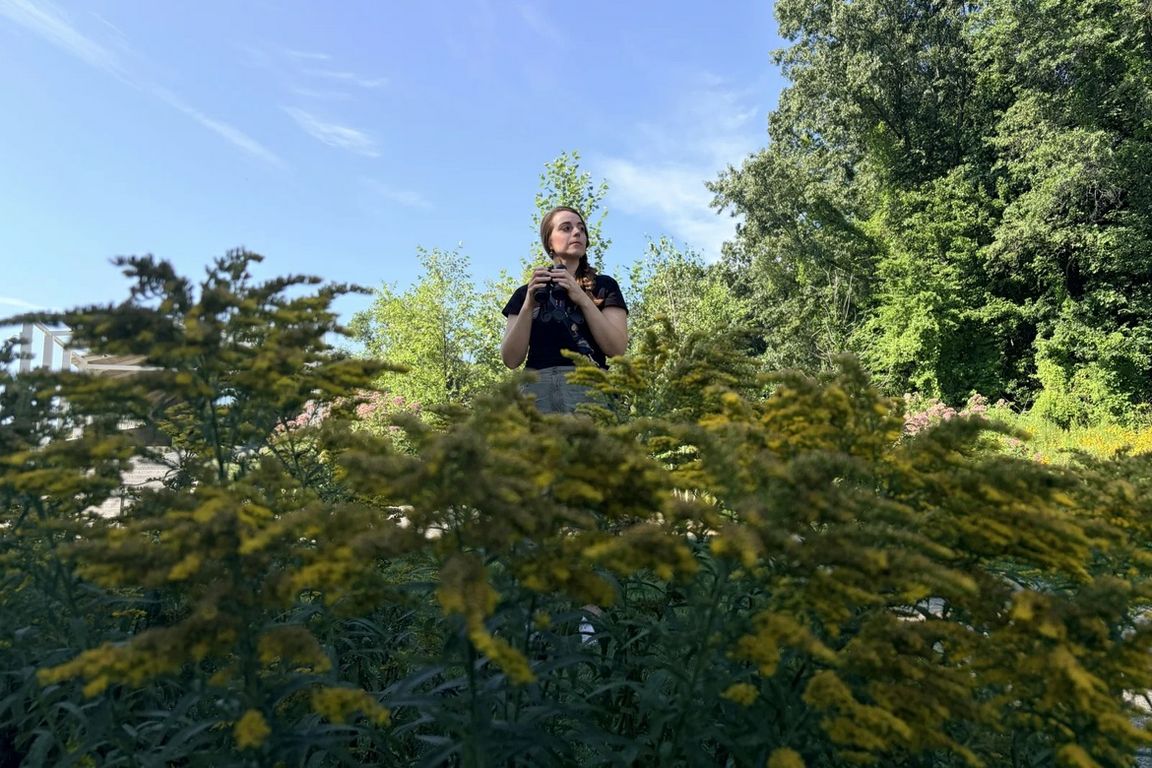
NPR spoke with UCLA ecologist Morgan Tingley about how birds may provide valuable data on the toxic effects of wildfires on both animals and humans. Tingley, a leader in the burgeoning field of smoke ecology, joins other scientists in rethinking traditional approaches to studying smoke, especially as the world experiences more wildfires. Read more about UCLA in today’s Fortune, Los Angeles Times and other outlets.
See our UCLA in the News daily archive.
More highlights from UCLA in the News: October 6, 2026
How is the Yosemite toad contracting a deadly infection? | BBC Wildlife
A deadly fungus known as Batrachochytrium dendrobatidis (Bd) is devastating amphibian populations around the world. Now, biologists from the University of California, Los Angeles, believe one of these threatened amphibian species — the Yosemite toad — may be infected by the fungus in a previously unknown way: through its burrows. (UCLA’s Dave Daversa and Jamie Lloyd-Smith were quoted.)
The secret animal world beneath the Hollywood sign | The Guardian
The Educational Research Center at the University of California, Los Angeles, has designated Griffith Park a Significant Ecological Area, in part for its crucial role “as a corridor for any gene flow and species movement between the Santa Monica, San Gabriel and Verdugo Mountains”. Researchers have documented about 200 species of birds in the park, along with 50 species of butterflies and 40 species of mammals.
Why ‘China plus one’ is paying off less than Southeast Asia hoped | Fortune
“While jobs are created in Southeast Asia, they are largely low-skill assembly roles,” Christopher Tang, a supply-chain management expert at UCLA’s Anderson School of Management, explains. “This caps the immediate creation of high-value industries.”
Here’s how to study so you remember what you learn | Los Angeles Times
Highlighting or underlining and repeatedly reviewing notes feels engaging because those approaches keep you focused for a short period. But studies show they don’t make a significant difference long-term either, said Robert Bjork, professor emeritus of cognitive psychology at UCLA, where he founded the Bjork Learning and Forgetting Lab with his wife, Elizabeth. In fact, that kind of “mass practice can be very wasteful of time,” Bjork said.
Revealed: the methane mega-leaks from UN climate summit host Turkey | The Guardian
In fact, its average emission rate of 7.4 tons an hour makes it one of the worst identified anywhere in the world by a team of expert researchers at [UCLA]. The planet-warming impact of this single leak is equivalent to 1.5m gas-guzzling SUVs gunning their engines, and there are more super-emitting dumps across Turkey. They stretch from İzmir in the west, to Ankara in the center, and Antalya in the south, many with “mind-bogglingly large” leaks, the UCLA researchers said. (UCLA’s Cara Horowitz was quoted.)
Poll: Latino voters swing away from Trump and GOP | KNBC-TV
“So, we interviewed 1250 Latino voters in Texas and another 1250 Latino voters in California. And we found overwhelming concern about the economy, severe frustration with what’s been happening in Washington, a real disdain for the incumbent administration in Washington, and a desire to see things change,” said UCLA’s Gary Segura.
Russian lab worker dies in lab accident | KTLA-TV
“Pneumonic plague is the respiratory form, you can potentially get it from person to person, spread through respiratory droplets,” said UCLA’s Anne Rimoin (approx. 1:45 mark). Rimoin was also interviewed about Ebola cases in the Democratic Republic of the Congo by BBC News.)
The team behind this soap opera is branching into microdramas | Los Angeles Times
While soap operas historically targeted a mostly female audience, microdramas reach a much broader audience, said Michael Berry, director of UCLA’s Center for Chinese Studies, who has studied the rise of vertical series. “It gives us essentially the main beats that we would get from a soap opera format, but it’s happening in a much more compact and addictive way,” he added.