The researchers demonstrated that the device could accurately identify handwritten numbers and items of clothing — both commonly used tests in AI studies.
The UCLA Connection Lab, to be led by Leonard Kleinrock, will foster interdisciplinary research on a range of technologies, such as blockchain, computer networks, big data and artificial intelligence.
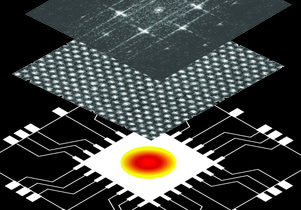
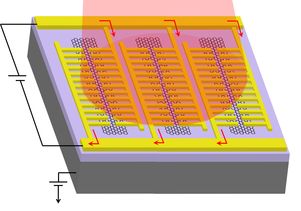
The device, designed by UCLA Engineering researchers, operates across a broad range of light, processes images more quickly and is more sensitive to low levels of light than current models.
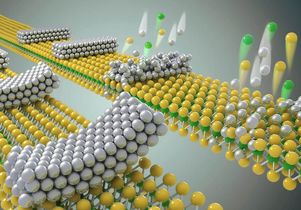
Their method joins a semiconductor layer and a metal electrode layer without the atomic-level defects that typically occur as part of the process commonly used now.
“Tissues are wonderfully complex structures, so to engineer artificial versions of them that function properly, we have to recreate their complexity,” said UCLA professor Ali Khademhosseini.
The advance could help bring high-quality medical diagnostics into resource-poor regions, where people otherwise do not have access to high-end technology.
Working to upend one of the most stalwart of construction materials, a team of UCLA researchers created a near carbon dioxide-neutral version of concrete.
In experiments the device produced 30 percent better capacitance — the measure of a device’s ability to store an electric charge — for its mass compared to the best available electrode made from similar materials.
Hong shares what it was like to run a leg in the torch relay for the 2018 Winter Olympics in Pyeongchang, South Korea, and the future of robot athletics.
The new technique sheds light on the materials the artist used, and the order in which they were applied to the painting. It also helped scientists uncover insights about the painting’s connections to other work from the same era.
As electronic devices have become smaller, using silicon components to power them has become more challenging; a team of faculty and students has developed a promising solution.
The new technique produces better images than current methods, and it’s easier to implement because it requires fewer measurements and performs computations faster.