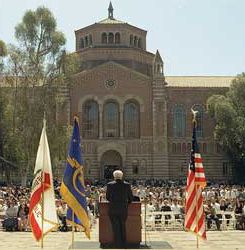
In the anguished days that followed the horrors of September 11, 2001, members of the UCLA community struggled to find their bearings in a world that would never be the same. Campus leaders conferred on campus security and emergency preparedness. Counselors at the Staff and Faculty Counseling Center offered their services 24/7. A campus memorial brought 5,000 Bruins and fellow Angelenos together at Dickson Plaza.
And faculty, administrators and staff continued to prepare for the fall quarter. With classes set to start on Sept. 25, just two weeks after the terrorist attacks, many worried how students would cope.
Recalled Judith Smith, vice provost for undergraduate education, "Students were coming to campus after an event that was big and scary, with many uncertainties as to what was going on."
History Professor James Gelvin remembered feeling particularly concerned about freshmen, "some of whom were going to be away from home for the first time and all of whom were entering a new and possibly bewildering phase in their education and life."
In his remarks at the campus memorial, Chancellor Emeritus Albert Carnesale said that "the time has come for us to come together to speak to one another, to hear one another, to teach one another and to learn from one another."
It was this "teachable moment," Smith recalled, that became the impetus for the creation of a series of one-unit, ungraded seminars limited to 10 to 15 students that would connect undergraduates, particularly freshmen, with faculty in a new way: through dialogue as a way of addressing the wide-ranging issues emerging from 9/11. Smith pulled together a team of some two dozen faculty and staff with a single goal: to have 50 seminars in place — under the auspices of the Honors Collegium in the College of Letters and Science — by the time the new quarter began.
"It was a village that came together very quickly," Smith recalled. "We had key people from the College, the Registrar’s Office and other parts of campus. We had a very tight schedule to identify faculty, find class spaces and let incoming students know about this new kind of class."
Ultimately, 57 faculty volunteered to teach the seminars, with another 28 signed on for the following quarter. "It was a very rich offering," Smith recalled of the classes, whose faculty included Chancellor Carnesale, teaching "National Security in the 21st Century," and former Provost Brian Copenhaver teaching "War, Terror and Violence: Reflecting on Machiavelli."
Historian Gelvin, whose field of expertise is modern Middle Eastern history, taught "al-Qaeda and Jihadi Islam," in which he guided his students through jihadi texts. "It was good to have the students ponder and discuss the texts rather then basing their knowledge of events on hearsay or Fox News," he recalled, adding, "I had expected students to be overwhelmed by events and perhaps a bit Islamophobic. I found they were neither."
Teofilo Ruiz, Distinguished Professor in the departments of History and Portuguese, taught a class on Christian, Jewish and Muslim relations. "That Fiat Lux class was among the most rewarding experiences I have ever had as a teacher," he said. "It ended up as a vivid discussion on politics and on what is right or wrong."
So successful were the seminars that the program was extended beyond those first two quarters, and Smith gave it a name: Fiat Lux, or "Let there be light," the University of California’s motto. "I thought that name was fitting because each faculty member was providing a little inner light," she said.
A decade later, many who taught those first seminars in 2001, Gelvin among them, continue to address timely topics year after year through Fiat Lux. In fall, 2003, following the American invasion of Iraq, he taught a class on relations between the United States and the Middle East. His recent seminars have addressed uprisings in Tunisia, Egypt and elsewhere in the Arab world.
Students enjoy Fiat Lux classes so much that they often take more than one, said Smith. "For students, having this chance to dialogue is really important. They’ll say, ‘I got to know a faculty member,’ an experience that’s not available in larger classes." In a survey of students who took Fiat Lux classes in 2003-04, many remarked on the rapport they experienced with their instructors. Commented one student, "The smaller environment … helped to facilitate discussion, interaction and a more enjoyable and stimulating learning environment."
Just as importantly, Smith added, students seem to connect with peers on a deeper level in Fiat Lux. Noted one student: "The quality of interaction with other students was fabulous. Oftentimes, our conversations would continue past the class, out the door and all the way back to the dorms. I have become good friends with them."
As Fiat Lux has matured, its offerings have grown more expansive. "The range of topics is really quite remarkable," said Smith. Among the hundreds of classes have been "The Sights and Sounds of L.A.'s Civil Unrest: Politics, Media, and Music," "Straight Talk on the Effects of Silence on Sexual and Gender Minorities in Los Angeles," "Is a Non-Violent World Possible? and "What is Language and Where Does It Come From?"
This fall, Ruiz will teach two classes, one on Jane Austen’s "Pride and Prejudice" — "because I love Jane Austen, and I think she gives us a very good entry into the social world of the early 19th century" — and another on "Dystopias, ‘Brave New World’ and ‘1984.’"
So committed is Ruiz to Fiat Lux that he has taken on the additional role of program chair.
"These seminar-based classes are a formidable heuristic tool," he wrote. "This form of teaching is at the very heart of what education ought to be: an opportunity to engage faculty and students in thoughtful and collegial discussions about an array of topics. … In true Socratic fashion, we are asking our students to embrace a reflective life."
Reflecting back to the start of Fiat Lux, Gelvin said, "Faculty who taught the classes were beneficiaries of the program. I don't mean this in the usual banal ‘I have learned so much from my students’ way. After 9/11, no one really knew what to do or even how to act. The event engendered a sense of wanting to do something. The Fiat Lux program provided faculty with that opportunity."