Hans Block and Moritz Riesewieck featured Sarah T. Roberts in “The Cleaners” — their movie about the anonymous people who screen objectionable content on social media.
The $3.7 million, three-year grant will go toward research aimed to develop imaging technology that allows the recording of tens of thousands of neurons to better understand how the brain goes awry in disease.
Learn about nanotechnology, meteorites and dinosaurs, among other science topics. Actress, author and mathematics alumna Danica McKellar will receive a science and education award.
The free event will include moon dust, meteorites and lunar experts. The viewing is part of International Observe the Moon Night, an annual worldwide celebration that encourages appreciation of the moon.
UCLA’s James Stigler is working to improve math and science education nationally by eliminating the rote memorization methods and studying what really works.
Researchers from the School of Dentistry and the David Geffen School of Medicine will use a technology created in the lab of Dr. David Wong from the dental school.
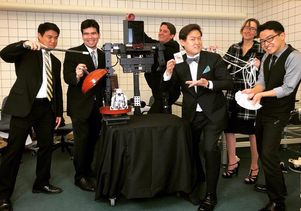
For the past five years, more than 250 UCLA undergraduates have designed and built a small satellite that will launch into orbit to study space weather.
UCLA researchers have found that an often overlooked component of a cell, the extracellular matrix, can influence how much sugar the cell consumes and its migratory behavior.
“We expect several of these combinations, or more, will work much better than existing antibiotics,” said Pamela Yeh, one of the study’s two senior authors and a UCLA assistant professor of ecology and evolutionary biology.
In tests at the U.S. Department of Energy’s National Renewable Energy Laboratory, the device converted 22.4 percent of the incoming energy from the sun, a record for that type of cell.
The research provides the first direct evidence of the proteins moving through PTEX, the protein complex that transports malaria proteins into the red blood cell.
A UCLA team has developed a set of outcome measures using a software program that aggregates the latest research and expertise about how to treat conditions.
The results could have implications for treating cancer, when people’s blood-forming stem cells may be depleted, and for people undergoing transplant surgery.