Against all odds, my father and I reached a breakthrough.
After years of politely thanking me for each June’s new necktie — each more creatively colored than the last — he finally told me what a more astute son would have picked up on long, long before: He wasn’t saving them for special occasions that never came. He just didn’t like any of them. That honesty, however overdue, turned out to be the best present either of us could have asked for: The way we laughed about it all helped unlock other conversations, too.
Feeling closer to our fathers is a deeply important need that’s getting talked about more and more. According to a recent report from the Center for Scholars & Storytellers at UCLA, joyful fatherhood is the most requested portrayal of masculinity by Gen Z and Gen Alpha.
Father’s Day hits all of us differently. But it’s a good opportunity to think about the changing face of fatherhood — and how we talk, think and (dad) joke about a topic that touches all of us.
After all, perhaps the best thing we can all give each other may be just sharing our stories. Here’s a present we hope suits everyone’s taste: five unique spotlights on fatherhood, all with a Bruin twist.
“Being a father defines who I am”
When Cleo Ware earns his bachelor’s degree from UCLA this month, he will be the first to admit he isn’t doing it just for himself. Actually, the softspoken 41-year-old is surprised he is able to do it at all.
“I dropped out of high school years ago to work to support my mom and my siblings,” he says. “But eventually I knew something was missing — I needed something, stuck in a dead-end job. So I went back and got my GED and then started community college.”

What got Ware, a first-generation college student, to UCLA — and finally up there across that stage in June — was the love and support of his wife, Brandi, and their seven children: Kai, 24; Christopher, 18; Christian, 18; Kylie, 17; Kayla, 16, Christiano, 15; and Kamora, 1 1/2.
So how does he juggle it all successfully?
“As far as balancing fatherhood with school and everything else, there is no balance,” he says with a laugh, picking Kamora up as she wanders over mid-interview; she beams. “It’s literally taking it one day at a time, but I give all the credit to Brandi, who is the driving force behind us all.”
The two met as young adults. Brandi was dating Ware’s best friend at the time; with whom she had Kai. It wasn’t until their early twenties, when the friend had left the picture, that Ware and Brandi started dating and eventually got married. Coming into Kai’s life when he the child was about 3, Ware had no idea that six more children would be on the way.
In 2014, a social worker the couple knew, Miss Sonia, who admired the childcare facility they ran, as well as their commitment to volunteering in the community, asked Brandi if they had ever considered becoming foster parents. Miss Sonia knew of five siblings, all under the age of 10, who were stuck in the system. Custodial rights had already been removed from the children’s birth parents, but because the judge refused to separate the kids, it was proving impossible to find someone to adopt all five together.
“I was at work when my wife met with Miss Sonia, so when I got home, she told me what she had learned,” Ware says. “I looked at Brandi and immediately said, ‘Okay, we're adopting five children.’”
The journey from fostering to adoption was lengthy and complicated. With nearly round-the-clock supervision and frequent visits from social workers, lawyers, psychologists and other professionals, Ware and Brandi had to work hard and get creative to build quality family time. It wasn’t easy, especially when something as seemingly simple as a trip across town to the beach required written statements from all involved and formal approval from a judge and social workers.
So when the day came that the adoption was finally official, Ware took a minute to really process what it meant.
“It felt like we could finally start living — if Brandi and I decided we wanted to take our kids on vacation, we finally could,” he says quietly, each word speaking volumes. “The feeling that we could finally say we’re a family and just be a family was so important.”
Biology doesn’t have to have anything to do with being a father, he adds, and encourages people to consider fostering and adopting as vital, wonderful options.
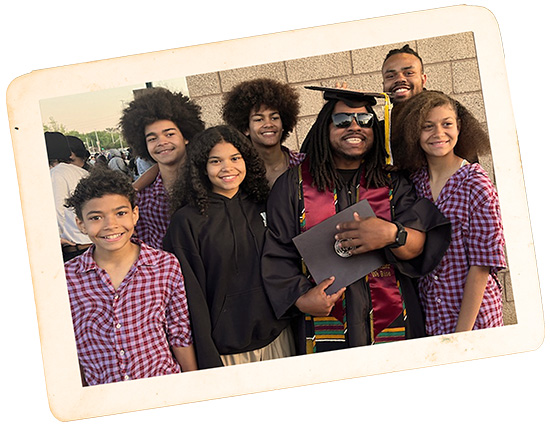
“The sheer number of children in the system who could use a good home should move us all,” he says. “If you’re considering becoming a father and are ever questioning whether it will be worth it, I can tell you that there is nothing like being able to have an impact on a child’s life. For me, I see my reasons literally in front of me, accomplishing things big and small, and I am in awe.”
Ware, who grew up with a difficult relationship with his own father — “the blueprint for everything that I knew I didn’t want to be or do” — refused to allow the challenges of his own life to ever eclipse the work of creating a family. They, after all, are the reason he was able to make it to UCLA and to earn his degree in political science — and to make the decision for his next step: law school.
“I would like to become a criminal defense attorney,” he says. “Growing up, a lot of my family members, friends and I experienced issues where good legal counsel would have really helped us make positive changes.
“I want to have the knowledge and ability necessary to help others — especially teen boys — who may find themselves in similar situations make good decisions, bounce back after mistakes and stay on their best paths. Ultimately, I want to be the person for them that I needed when I was 16.”
He is already that person for his seven children. The pride in his voice is palpable when he talks about setting a good example for them and speaks of his hope that all he has achieved will make their own journeys a little easier, their aim a little higher.
“I was introduced to Kai when he was about 3 and I was 20,” he says. “So I was a father even before I was a man. Being a father defines who I am.”
“A person and a parent”
Part of the pain of losing your father can be the feeling that not enough people knew him or what made him so special. So it was a small comfort for Mike de la Rocha ’00 — a spiritually focused surfer and singer-songwriter — that this wasn’t the case for him and his late father, Ismael “Mayo” de la Rocha.
A native of Chihuahua, Mexico who emigrated to Boyle Heights, the elder de la Rocha grew up during the height of the Civil Rights Movement in the 1960s. He came into his own while attending UC Santa Barbara.
“He found his voice in the Chicano movement, and as a result of that and his love of history, he became a community college professor for over 40 years at Ventura Community College,” his son remembers. “He dedicated his life to uplifting students of color: helping them get to know their history and selves with a sense of pride, and [providing them] a pathway to opportunities that maybe their own parents and/or families may not have ever had access to.”
Unmoored by his father’s death in 2015, the younger de la Rocha wanted to write his father’s biography, but struggled with how to properly capture and honor him — to unlock his complicated humanity and more fully place him in the context of a world that shaped him and that he himself helped shape.
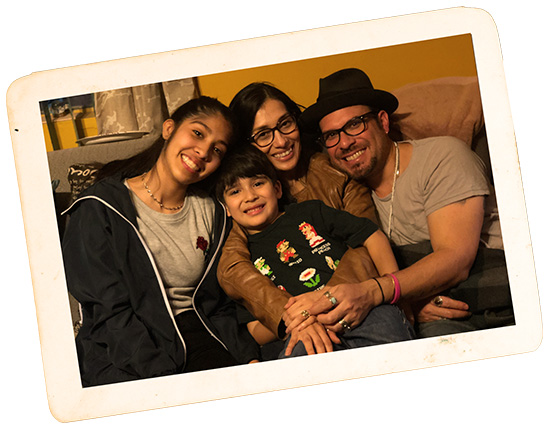
“So much of history is made by folks who are unknown and unseen,” de la Rocha says. “There’s millions of folks whose sacrifice allowed each of us to be where we are today.”
When the words wouldn’t come, the son realized that the story he needed to tell wasn’t just his father’s, but his own as well.
“I realized I was hiding behind his voice, because I hadn’t processed the immense grief of losing the most important man in my life,” he says. “But once I started writing deeply about our relationship and everything I learned from his passing, going to therapy, and digging into African and Indigenous cultural practices, I was able to start healing.”
Unpacking long-standing cultural and societal conditioning on expectations for masculinity, including the idea that men should not be emotionally expressive or ask for help, de la Rocha traced the harm these ideas had caused in his own family across generations.
“The moment you start to see your father as a person and not a parent, it might help you better understand their challenges and their rationale for how they raised you,” he says. “Fathers oftentimes don’t get acknowledged for the extreme weight and unfair expectations that society can place on them.”
Armed with clear-eyed empathy, he wrote about his journey to greater understanding in his book Sacred Lessons: Teaching My Father How to Love, which resulted in a spin-off podcast where he now interviews men about wellness and mental health.
“I’m committed to finding ways to ‘call in’ rather than ‘call out’ men to return home to their beautiful selves. When they are ready to heal, they won't heal alone,” he says. “Healing is a communal journey and effort.”
Alum Mike de la Rocha shares his thoughts on fatherhood — and the deep pride he feels in his graduating Bruin daughter. Watch here:
To watch an audio descriptive version of Sacred Lessons, click here.
“The most solid and rooted and reasonable word I’ve ever used to describe myself”
Growing up in a San Fernando Valley home steeped in conservative Iranian values, shawndeez M.A. ’17, Ph.D. ’22 never thought fatherhood was in his future. (shawndeez, who uses he/they pronouns, does not capitalize his name and does not use a surname.)
“Because I’m trans, and the idea was always positioned as being a ‘mother,’ I just rejected it entirely and walked in the opposite direction at the speed of light,” he says. “I couldn’t really entertain being a parent until I transitioned to be in a body that made sense to me.”
So how did the journey go from there? A smile slowly grows as shawndeez — who has deeply kind eyes and a thoughtful, measured way of choosing his words — thinks.
“There’s still this very large mountain that you have to climb to be a trans parent. It's not very straightforward and I just thought, That's too much, that's too hard. I can't do that,” he says. “But then I had a very good friend, an Iranian trans guy as well, who did it. They FaceTimed us from the delivery room to show my partner and me the baby. We just sat on the couch, overcome.”
That was all it took — less than five months later, shawndeez and his partner were pregnant via reciprocal IVF they had done at UCLA Health, where shawndeez provided the egg and his wife carried it. Today, they’re the parents of two kids: The first just turned 3; the second is about 6 months.
Now, he and his family live in rural Colorado — “a crazy change from L.A., but absolutely the right place for me,” he laughs — where he works as a speaker and spiritual counselor. He’s happy to offer his wisdom to any potential or current father.
An issue many of them have is one that shawndeez himself continues to navigate.
“I have not had a present father in my life for, we’ll say, over a decade. So what does it mean to become a father without one?” he asks softly. “The extreme joy you feel in becoming a father yourself can be matched sometimes by an almost equal sadness that this person who’s your father isn’t here.”
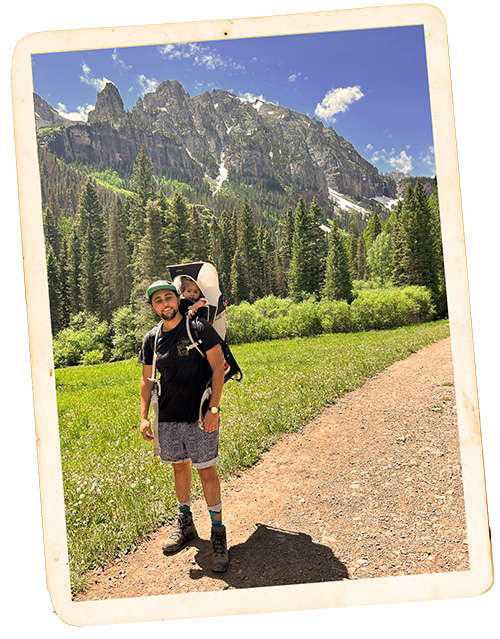
It’s tempting to believe there’s a cosmic symmetry in this, he says, that traditional gender roles have enforced the idea that what it means to be a father is somehow “deeply stitched to loneliness” — that traditionally, men should draw their full strength from silence and self-sufficiency and model it as an example.
“I don't like that. I don't believe it. I don't buy into that,” shawndeez says with quiet force. “I see that part of my story has that flavor. I do see that, but I also take it upon myself to make sure that’s not the tone of what fatherhood means.”
For him, fatherhood is open-hearted, full-force engagement. Working from home and teaching his kids Persian — shawndeez created a language game for his older daughter, whose pride in sharing her culture with her peers makes him proud — he feels right where he belongs: creating his own story, his own family.
“I remember when we got through those first few weeks and months, my wife and I would laugh. We'd be like, ‘Oh, are you like, are you mommy now?’ ‘Am I baba now?” he says. “I use ‘baba,’ which is Farsi for father,” he says.
“At first it all sounded a little uncomfortable, a little unfamiliar. But now it's the most solid and rooted and reasonable word I’ve ever used to describe myself, and I think that means something. I think that means everything.”
That doesn’t mean parenting is easy or ever will be, he adds, but whenever he needs to recenter and recharge, he thinks back to the first night after his daughter was born. She and his wife had both finally fallen asleep.
“I was just weeping, holding this tiny baby; I was alone, but I wasn’t,” he says. “I looked at my daughter; I felt the words: ‘Why did it take me so long to figure out that I wanted you?’”
And instead of simply the happy ending that fatherhood seemed as if it could be — the reward for all the growth and discoveries he had achieved along the way — shawndeez instead realized it’s much more than that. It’s yet another beginning.
“All those journeys I took before were precursors — my real journey was actually to become a father,” he says, emotion filling his voice. “I see in myself and how I was raised these really strong core tenets of Iranian love, hospitality and caretaking that allow me to be the type of father that I am. So I realize now that there would be no me without the journey to Baba.”
“An adventure one way or another”
Lanky and clean-cut — the phrase “All-American” comes to mind — Bob Murphy is a unique brand of Bruin dad.
You see, he didn’t actually go to UCLA himself. But both of his children did, graduating with bachelor’s degrees in geology (son Dillon Murphy ’16) and cognitive science (daughter Mackenzie Murphy Marynak ’19). Still, for Bob and his wife, Deidre, proud alumni of San Diego State University who met on their very first day of school, their circuitous connection to UCLA is strong.
“We felt welcomed from the very beginning as part of UCLA — people were actually really excited that we served on the Parents’ Council and on the Dean’s Advisory Committee for Undergraduate Education, even though we were the only non-alumni members,” he says. “I would like to think that we bleed just as blue and gold as alumni do. Maybe more.”
The deep connection the Murphys feel to UCLA dovetails with their lifelong commitment to public education — and to family.
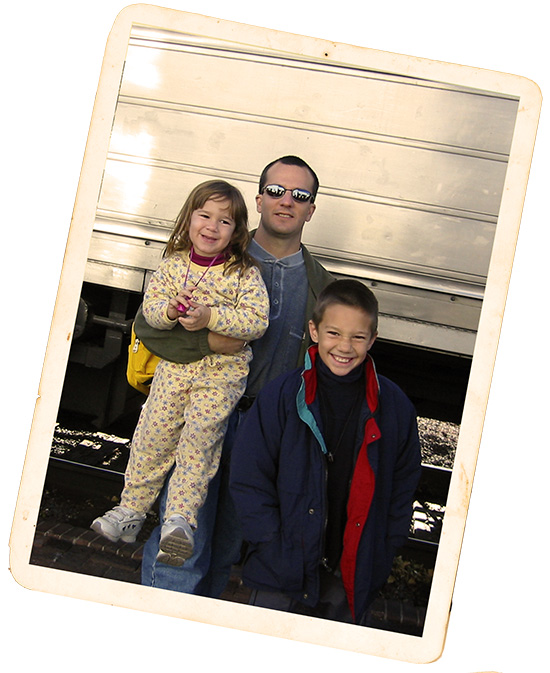
The Alzheimer’s disease–related death of Bob’s mother inspired the couple to create the Barbara C. Murphy Memorial Scholarship at UCLA in her honor. It supports undergraduate students interested in research focused on neurodegenerative diseases. The positive experience their children had as Bruin students moved them to also create the Murphy Family Centennial Scholars Undergraduate Scholarship, which supports undergraduate students interested in the physical or life sciences.
To raise money for both, Bob Murphy has taken on quite the adventure: participating in the marathon cycling event Race Across America. As part of a four-man cycling team (supported by a dozen crew members), Murphy will depart from Oceanside, California and cross the country on his bike until the team reaches the famed Boardwalk in Atlantic City, New Jersey.
“Our goal is to break the current record for the 60–69 age group by finishing in approximately 6.6 days. I’m a little nervous with the training involved, but it’s going to be an adventure one way or another,” he says with a laugh. “My kids think I’m nuts. But they also think it’s cool — my daughter was one of the first to join my crew. My wife is less convinced.”
Deidre will still be cheering Murphy on, though. As will his entire family, including his new granddaughter, Ava.
“Becoming a grandfather really put a unique focus on what it means to be a father,” he says. “It makes me especially proud to see my son begin his own journey as a dad and to do it so well.”
Although the Murphys have now moved from Southern California to Reno to be closer to their kids, they’re keeping their UCLA football tickets … and their eyes on Ava’s future.
“We already have the Bruin gear ready for her,” Murphy says, his eyes sparkling. “She just needs to grow into it.”
“Fatherhood is both innate and learned”
“Motherhood and fatherhood are both very special,” says Darby Saxbe M.A. ’04, Ph.D. ’09, one of the world’s only researchers collecting longitudinal neuroimaging research on new fathers. She pauses. “But there are a couple really cool things about fatherhood.”
Saxbe’s eyes sparkle. She loves talking about all the cool things, not just a couple, and her wealth of findings has been cataloged — with a sharp sense of humor — in her new book, Dad Brain: The New Science of Fatherhood and How It Shapes Men’s Lives.
“If we’re interested in neuroplasticity — because who isn’t, really? — dads don’t experience pregnancy directly, but we also see all these neurobiological changes in them,” she says. “The idea that our experience and our investments can change us physically and mentally is really powerful.”
That’s right — while it’s well-known that many aspects of mothers’ bodies change during pregnancy and after childbirth, Saxbe’s research shows that similar things happen to fathers. Giving new meaning to the term “dad bod”: Across multiple species, studies show that the archetypal “dad bod” body type sends a clear message of fatherhood readiness and ability.
Going even deeper, scientific scans demonstrate that the brains of new fathers lose volume in the same regions as those of new mothers. Instead of being cause for alarm, however, this streamlining actually reflects a stronger bond with their child and a more intense focus on parenting. It’s also further proof that human brains and bodies are adaptable based on what they’re called upon to do, instead of being hardwired to fulfill certain prescribed roles.
“I’ve heard people argue against paternity leave because mothers are supposedly wired to take care of kids, and therefore they’re the ones that should be home,” Saxbe says. “But when you start to recognize that the research is telling a different story and challenging our assumptions, it opens up a lot more possibility for flexibility.”
Saxbe experienced this firsthand with her own father, about whom she writes movingly in her book. A hands-off parent, her father at first became unmoored when his wife left the marriage and he suddenly had primary custody of four children as a single dad.
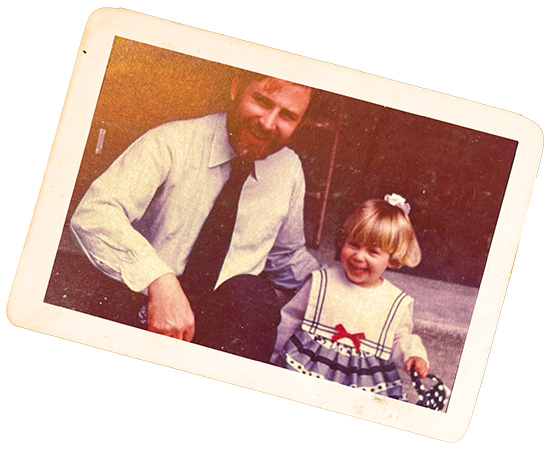
This sudden new role caused him to unexpectedly become a reinvigorated person and parent — sewing custom patches for his kids’ backpacks, designing letterhead for the family’s cats, building a three-story treehouse. And it made an indelible impact on Saxbe’s and her siblings’ lives.
The same was true of her mother’s second husband, who deeply enjoyed doing all the family’s cooking and errands. Both men — and, specifically, their willingness to grow and change — helped inspire Saxbe’s scientific direction and her book.
“I had two men in my life who were really involved in raising us, and I think that's surprisingly unusual, especially as someone who grew up in the ’80s and ’90s,” she says. “As I say in the book, since humans have evolved to have an early childhood that requires such extensive care, we need all hands on deck to raise the next generation.
“Helping men feel empowered and welcomed into the caregiving web is really helpful to kids, it's really helpful to moms, and it’s really helpful to dads themselves,” she continues, “because I think there's a lot of meaning and a lot of purpose that can come from taking care of others.”
Today a professor of psychology at USC who proudly plays in a “mom band” originally formed at her kids’ school — the Dahli Mamas — Saxbe is proud that she can represent both Southern California universities that helped shape her and her work.
“So much of the research in my book was done on those two campuses,” she says. “It’s so important, too, especially at a time with all these funding cuts happening with science, for us all to acknowledge the value of higher education in advancing knowledge.”
Saxbe closes Dad Brain by describing a letter she received from her father 10 years ago that shed new light on how embracing being a dad didn’t constrict his life, but instead gave him a new and better one.
“[Caring for my siblings and me] gave him purpose and helped him put one foot in front of the other when he wanted to give up,” she writes. “Love transformed him, just as it transforms millions of men around the world who are engaging in the work of caring for others every single day. This book is for them.”
Read more from UCLA Magazine’s Summer 2026 issue.