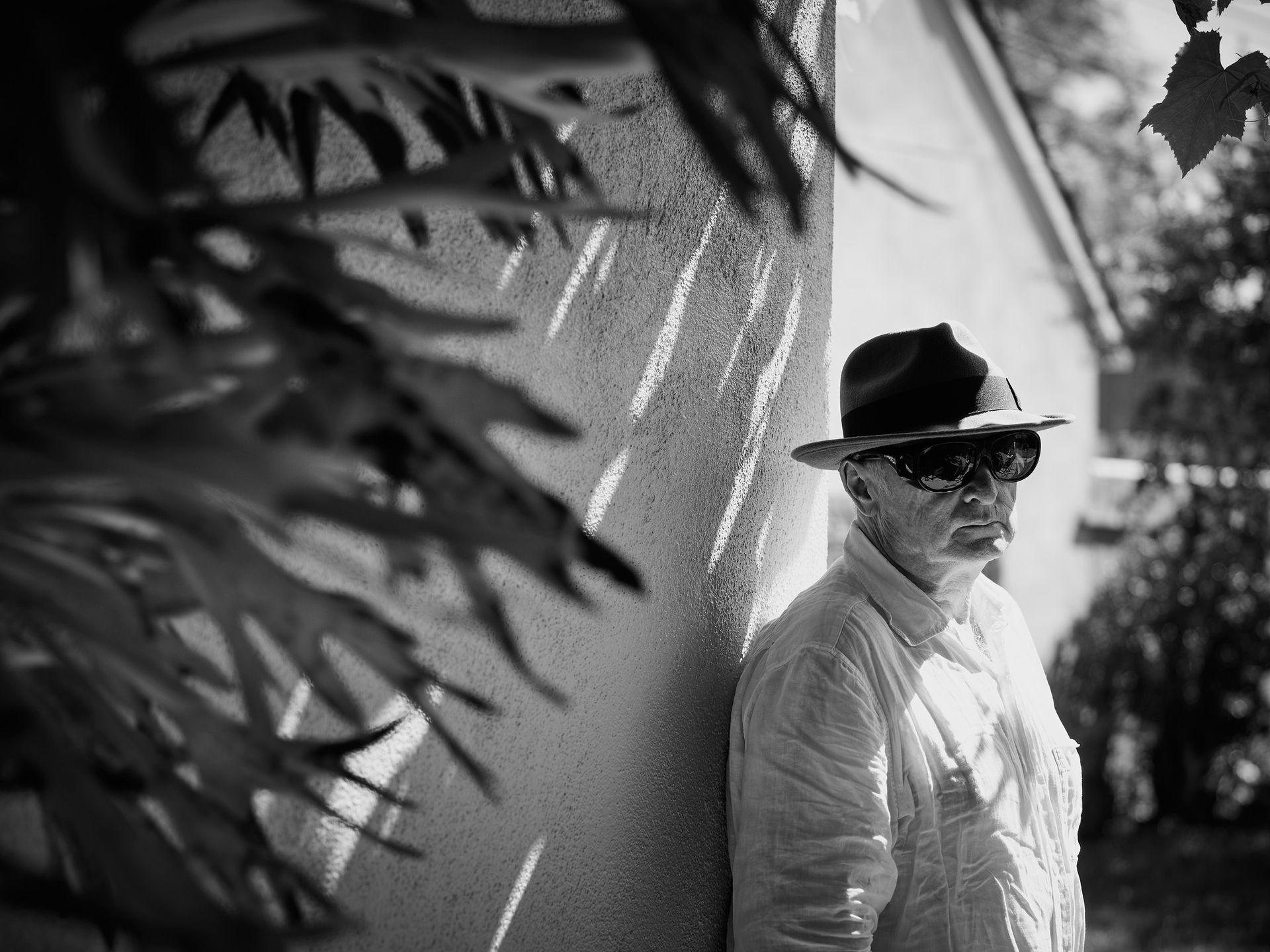
My first indication that something was terribly wrong was as I was looking down the side of the bed to a discarded print issue of The Economist. The magazine’s cover lines are usually reliably witty; this morning they looked like gibberish. What was going on?
I stumbled over our cat on the way to the bathroom to wash what I thought must surely be sleep from my eyes — then washed and rinsed again, amid a growing sense of disbelief, nausea and dread.
My eyes looked shockingly normal, a Celtic green thanks to a thinner-than-average layer of the pigment melanin over my iris. But behind the retina, something was just not working. I turned to my wife, Alison, and uttered fateful words. “I cannot see you very well.” She held me.
We had been here before.
A devastating diagnosis
Around 6 million Americans are blind, according to the U.S. Centers for Disease Control and Prevention, and every one of them has a terrifying story to tell. And yet these are lives that also find hope and purpose.
I lost nearly all sight in my right eye 20 years ago following an optic stroke. I was assured then that this was a pretty rare event, and that with my generally robust health, it was statistically unlikely to reoccur. There was just a 17% chance that a second blood clot would destroy my left eye, too. And then, in July 2025, it did.
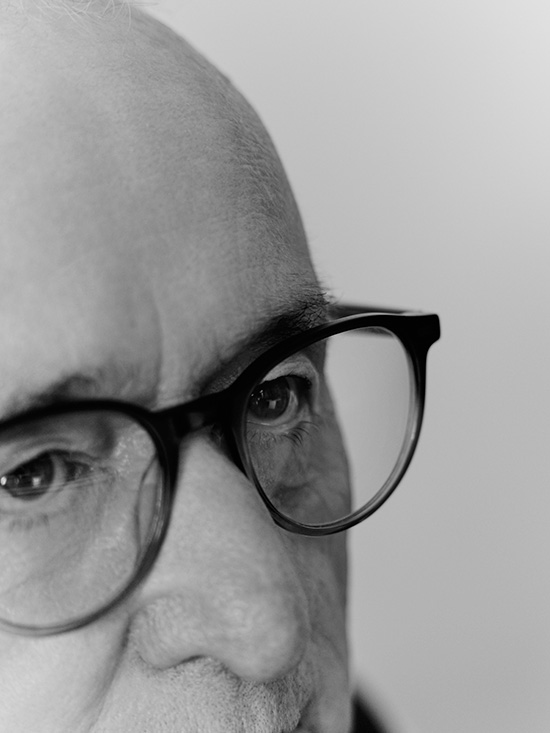
An optic stroke is a thief that steals your sight in the night. Imagine falling asleep in a 100-watt room and waking up in a 40-watt world. Everything near and far now presents in shades of brown and gray. Without symptoms, without understanding what is happening to you, without warning — abruptly, you are blind.
It’s estimated that every year, some 5,700 Americans lose their sight, totally or partially, to an affliction known as anterior ischemic optic neuropathy. I am now one of them. It’s extremely rare: I had a better chance of being bitten by a venomous snake. But on that hot summer night last year, when the circadian pulse is at its lowest and we are most vulnerable, my world went dark. It probably happened around 3:30 a.m. (known in folklore as the “devil’s hour,” when natural American deaths cluster). I know this because I had been woken before 2 a.m. by marauding raccoons and again at 4 a.m., when I mumbled curses into the darkness, which I sleepily assumed was exogenous. So I know exactly when my world changed. And why.
The fine doctors at the UCLA Jules Stein Eye Institute believe that a rogue blood clot jammed into the hole at the back of the eye. This “disk” holds in position the optic nerve that transmits imagery from the retina to the back of the brain. It’s likely that all 1.2 million ganglion fiber cells burned out in the blink of an eye — the human equivalent of a metropolitan blackout. And those cells do not regenerate.
The doctors told me that the risk factors for the stroke include obesity, sleep apnea, high blood pressure and “excessive use of Viagra,” which raised Alison’s eyebrows. But it turned out my source of woe was genetic. I had a “disk at risk.” The hole at the back of my eyeball was not wide enough to allow a breakaway clot from my bloodstream to simply squeeze past. Blood clots probably manage to do this for you all the time.
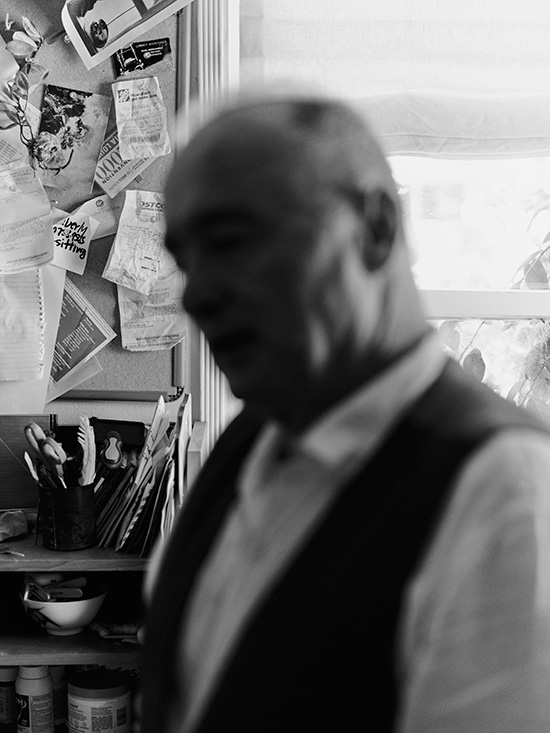
It reminded me of a storyline in the HBO drama The Pitt (acclaimed for its authenticity, which is partially down to advice from UCLA nurses). Over two episodes, the emergency room doctors undo the damage of a retinal stroke. While it may make for gripping television, it’s a risky Hail Mary in real life, my Stein neuro-ophthalmologist, Michael Gilhooley, told me. His advice: Cycle through Kübler-Ross past denial, bargaining and anger right on to acceptance.
I would no longer have any peripheral vision at all. My central vision seemed fine, at least at first: the TV glowed like an IMAX screen. And then, after another ministroke or an aftershock, that, too, dimmed.
The sense of loss still overwhelms and enrages me. I will never drive a car again, although I still dream of collecting speeding tickets on Mulholland, or seeing the dazzling displays of our hens’ feathers after a molt, or the blaze of a Californian superbloom in the desert. I will never again stride along rainforest or mountain paths with the idiot confidence of my past.
As we talked to the doctors, I felt a groan escape. My wonderful wife squeezed my hand. The future was here. And it was dark.
History repeating
In 2006, I was working as a reporter for The Sunday Times of London, stalking then Prince Charles around Bay Area drag clubs (he was said to love the queens impersonating his mother). In the heat of the job, I ignored a crescent shadow in my right eye, dismissing it as a pesky lash, until I woke the next day to discover that I had lost 95% of the sight in that eye.
For a week, I sat in my backyard feeling confused and sorry for myself. My friend and colleague Marie Colvin, who had lost an eye to a grenade while covering the Sri Lankan civil war, phoned to gently mock my aspirations to imitate her stylish piratical patch. I was never as cool as Marie, later murdered for her daring by the Syrian government.
I eventually did the only thing I could think of: I accepted the new normal and went back to work. The damage was not visible, then or now, and apart from missing out on the prettiness of 3D Avatar, life charged on largely unabated.
The second loss, last year, was to be life-changing.
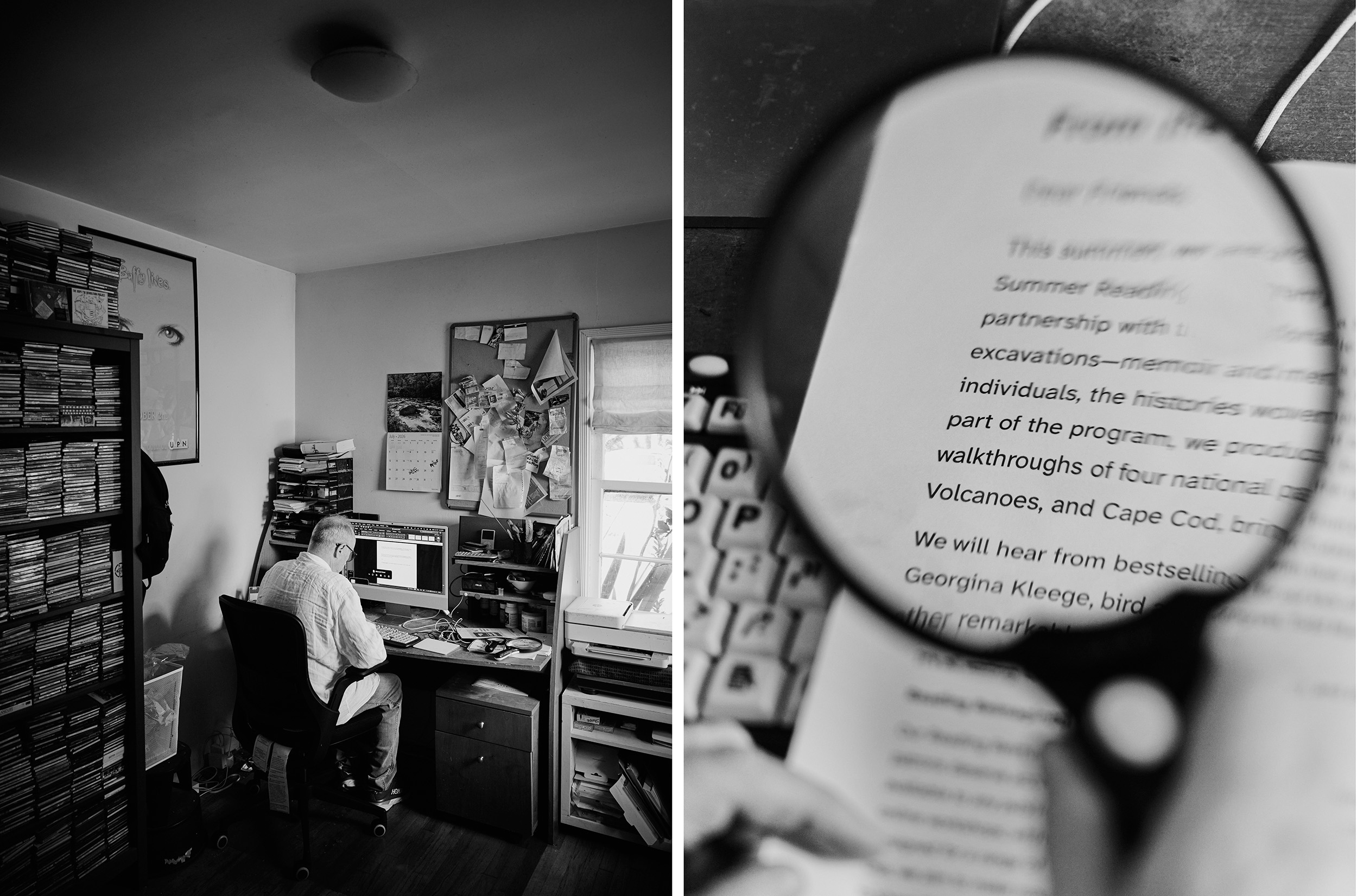
I penned my first novel at 5 years old and used an entire box of Crayons to finish the masterpiece; now I can’t read for more than 15 minutes without getting a headache. I have to read every word forward, backward, then forward again to fill in the missing letters. Black text in curly fonts or messy bright advertisements are actually painful.
I used to scan half a dozen newspapers before breakfast; now I am agonizingly dependent on bloated podcasts and banal TV news. I am glad that UCLA Newsroom reads out its stories to me, albeit with a voice only an AI mother could love.
I routinely reduce apparently invisible wine glasses to shards with an unseeing swipe. I stumble over our cat. Our hens are newly wary of this guardian-turned-Godzilla. Once I stood on battlefields; now I freeze at a farmers market, overwhelmed by stimuli. And I fear street curbs, now as irregular as British teeth, and rage at potholes.
And yet, as I am learning, I am far from alone. I am part of a new community that includes some extraordinary people. Among these are people at UCLA who have literally saved my life — and given me hope for what the rest of it may look like. So, as the reporter I remain, I went looking for my new people.
Rays of light — and hope — in the darkness
I have been uplifted by talking with people who have battled blindness and yet seem to live bigger lives than most abled people.
One critical new compadre was Itohan Ediae, now a fourth-year undergraduate at the UCLA School of Theater, Film and Television. Itohan is the kind of student you always associate with UCLA: bright and inquisitive, sparkly and funny and engaged with the world. Originally from the Bay Area, she was born with the albinism skin pigmentation condition, which carries with it a related eye condition called nystagmus, which distorts how she sees light and distance.
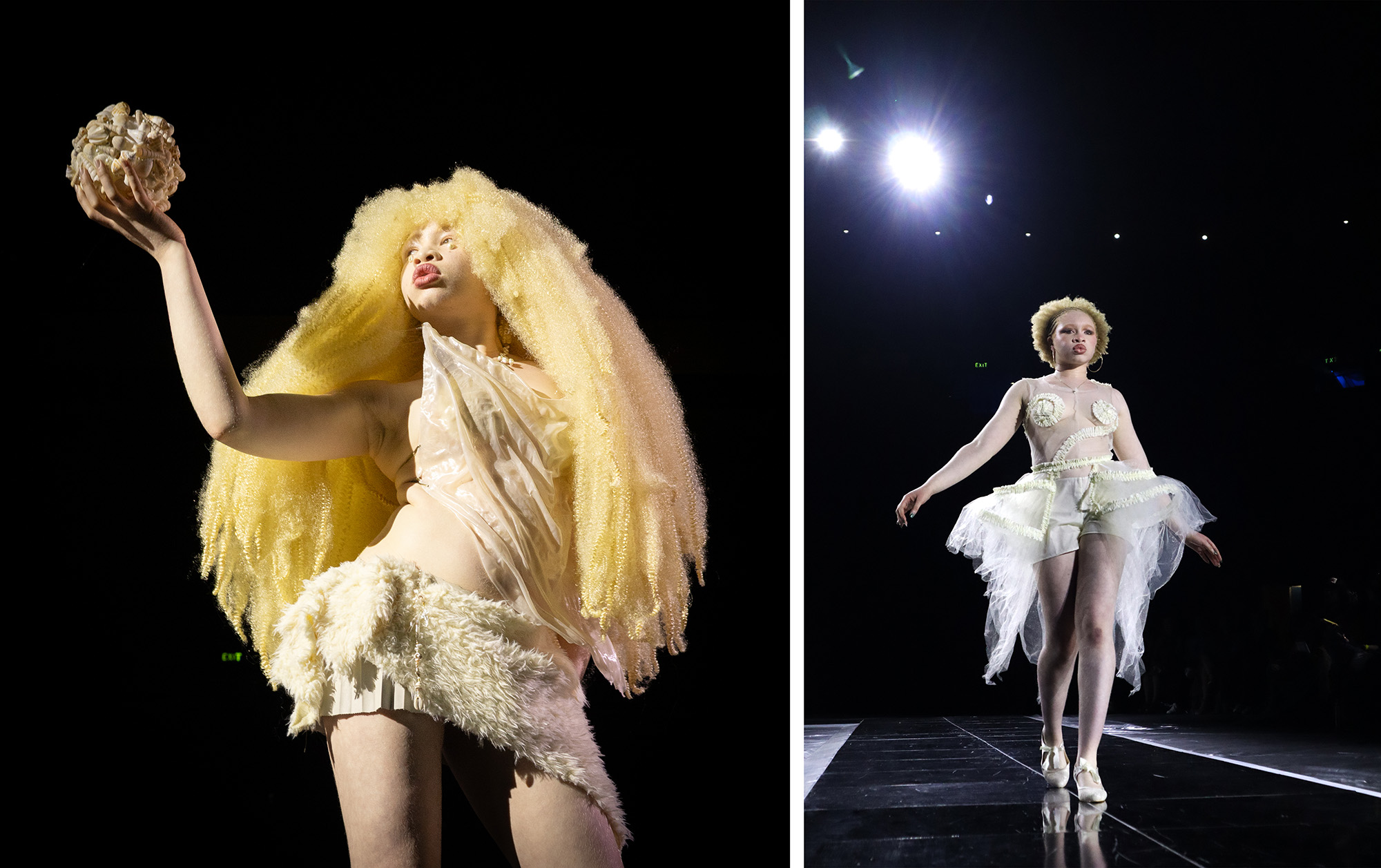
Despite what she feels is an overprotective family, along with the pain of schoolyard bullying, Itohan is no wallflower. She may not see very clearly, but she has always wanted to be seen, ideally on a public stage. As a theater major, not only does she relish her acting studies at TFT and where they might lead her, but on social media she follows Winnie Harlow, an acclaimed Canadian fashion model who campaigns for more understanding of diverse skin conditions. Earlier this year, Itohan herself blossomed during her own strut down the TFT fashion catwalk.
“I practiced a lot in advance; I did not want to walk off the edge, and it helped that I could not see the audience,” Itohan says. What you notice most in her voice is not the relaying of anxiety, but of joy. “But I could hear them, and it was great.”
Like many of us now foraging into new, different, and scarier territory, she’s conflicted about how to deal with new people. “We work in close groups in acting class.” she says. “Everyone knows, but when I find out that someone waved to me and I did not see them, that I did not wave back, I feel bad. But I do not want to be the center of attention for this. I am worried about being overlooked for acting job interviews if I mention it on my resume. Or I am only interviewed out of curiosity to see what I can do.” She says this last part resolutely. “I can do everything!”
We talk about language. We both reject the terms “handicapped” or even the traditionalist’s “crippled,” but ruefully acknowledge we are “legally blind” according to the DMV. We are “visually impaired”; maybe, just maybe, even “disabled.” But even then, only when faced with the Herculean challenge of Janss Steps, which we both agree should be turned into an escalator.
Our confidence, focus and sociability depend on how we are feeling that morning. I have been surprised to appreciate how deeply vision is metaphorically embedded in language. “I’ll see you” — even when we only intend to text. Blind as a bat, blind alley, playing a blinder (as we Brits say) … we, the sight-challenged, have enriched English, but, really, no need to thank us. We want to contribute.
Sometimes I suffer from imposter syndrome. I mean, I do have 20% sight remaining in my left eye, which is at least something. Only 10% of America’s millions of blind people are “totals,” meaning they are 100% blind. The rest of us see things fuzzily or in flickers, or walk through life feeling like Vaseline has been smeared over our eyes. Most people lose some sight as they age. Luckily, facilities like Jules Stein can often help. And ongoing research holds much promise.
The real Daredevil
Brandon Shin ’20 is a total, and the moniker actually fits him. Not because of his blindness, but because he is totally impressive.
I was introduced to Brandon by Paul McCarthy, the martial arts coordinator for UCLA Recreation at the John Wooden Center. McCarthy helps disabled students and staff grow more confident in their physicality through martial arts and other defensive systems.
Critically, Paul taught me the odd but necessary skill: how to fall safely. I wish I had had that knowledge when I stumbled on my own front steps, twisting my ankle. It was painful for weeks.
Brandon has been one of McCarthy’s star pupils. His journey began when he was 5 years old and lost sight in his right eye, followed by his left when he was 12. But neither loss curbed his kinetic energy.
Brandon was already an accomplished percussionist when his sight dimmed completely. He went on to play drums at his high school show at the Greek Theatre in Griffith Park. “I could just feel it all,” he recalls, still experiencing the thrill.
He found a grit he hadn’t known he possessed. “We had family skiing trips to Big Bear. After I had gotten through my initial feelings, which were tough, I went back,” he tells me. “With my uncle as my guide, I took on the runs, including a double black diamond (the most challenging run) at 40 mph, and it felt great.”
One of his most delicious memories is hearing a father encouraging his child to take to the powder by pointing at Brandon in his orange “blind” vest and saying, “If he can do it, so can you.”
At UCLA, Brandon learned jujitsu with McCarthy, identifying the location of his opponent via “echolocation,” issuing mouth clicks and judging distances, obstacles and moving forms by analyzing echoes, he says. Yes, like a bat. (The Xhosa and Zulu include such tongue-twisting clicks in their South African languages, immortalized through Miriam Makeba’s 1960s pop hit “The Click Song.”)
“I can detect furniture and walls as well as a person coming for me. When we are grappling, I can predict moves by their breath,” Brandon says. “We all exhale before a strike, but I am attuned to all the movements.”
Watch Brandon Shin practicing applied martial arts:
He learned these techniques from Brian Bushway, a Long Beach spatial mobility teacher. And, he says, it helped him navigate beyond the Wooden Center. It all feels like Daredevil, Marvel’s blind attorney by day and echo-locating crimefighter by night. I do think people like Brandon, now an English tutor, develop abilities to deal with everyday hazards that, while not supernatural, are nonetheless extraordinary.
At any given time, there are a few dozen visually impaired people around UCLA, says Spencer Scruggs, Director of the Center for Accessible Education. This fabulous cohort, my peeps, represent a fragment of the 7,000 embattled Bruins who pass through his doors each year. They are seeking accommodations such as more time to complete coursework, larger print textbooks and quiet spaces.
They’re fortunate to be here. UCLA started rethinking campus life in 1945 when veterans enrolled under the GI Bill. Needs have evolved, with anxiety and depression joining ADHD, dyslexia and Tourette’s syndrome (all dismissed as “attention seeking” just a few years ago) as rising challenges.
On UCLA’s hilly, bucolic campus, transport access (there are those Janss Steps again) and signage remain challenges to overcome, says Scruggs. “It can be easier to get around campus in a wheelchair than if you are visually impaired,” he says. “But we are working on it.”
So are other smart people around UCLA.
Dennis Hong, acclaimed professor of robotics at the UCLA Samueli School of Engineering, told me that he once designed a prototype for a car that could be driven by the blind. Even as he explained it, it sounded terrifying to me. But I was also exhilarated that such work was being considered and explored — even if that particular concept has probably been made moot by self-driving vehicles.
In 2013, the FDA approved the Argus II, a retinal prosthetic developed by Wentai Liu, a Samueli professor in electronics and computers. The work around it remains laborious and painstaking. But it could, one day, become part of the first artificial eye. The UC system is enrolled in a federal program to develop eye transplants, at some point in the future. Think about that, what it could mean for thousands of people. It’s astonishing.
All around UCLA, hope abounds. And solutions bubble.
A vision for the future
As for me, well, I call this bad news for people who like bad news. As much of a crusty curmudgeon as I am, I do have hope that, even after I retire from UCLA at the end of the year, life will get better.
I have found a new community and a new way of looking at the world. It will be smaller but still, in moments, beautiful.
I have stopped waking up every morning terrified that I have lost the rest of my sight. Statins and aspirin may be a placebo against the dark, but I now feel that maybe it’s not inevitable. I’m in safe hands.
I think of what I have experienced and am grateful, after the first shocking assault of vision loss, to have kept most of my sight for the past 20 years. I hope to keep what little I now have for the next 20.
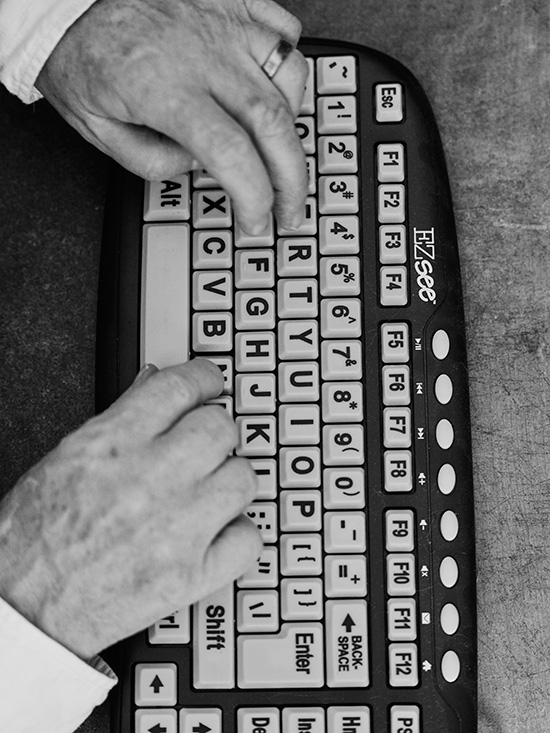
I am lucky that tech has grown during those two decades. The Braille Institute, where everyone seems to be named Jennifer, rejigged my phone settings to give me more access, which was unexpected and vital. The amazing human resources staff at UCLA swarmed around me and took charge, determined to keep me working and productive and to not let the blindness rob me of these last years of my career. That included providing me with an adorable wasp-colored keyboard with big buttons that would make anyone happy. And indeed, more productive. Text-to-speech is truly cool, although I will be eternally disappointed that ChatGPT fumbled their plot to make it sound like Scarlett Johansson.
I am learning to read again, slowly, even if that means scanning every word twice to catch missing letters in C-A-T. My domestic habits are changing. I am gesticulating less, so we are losing fewer wine glasses. And speaking of which, I have now learned to pour wine without inserting a nervous digit into the glass first. Cheers!
Alison and I even went on a long weekend trip to Nashville. I’ve spent my life in airports, and the hubbub was familiar and easy. Maybe our world will not be so small after all.
I believe life will continue to get better as I adjust. And I believe there are answers out there that UCLA will discover. People like me, living forever in gloom, will continue to trust in our university motto, forged more than a century ago.
Fiat lux — let there be light.
Read more from UCLA Magazine’s Fall 2026 issue.