Robinson shared the story of her awakening to the global impact of climate change on the world's impoverished countries and communities at a lecture hosted by the UCLA Luskin School of Public Affairs Tuesday.
The paper was published by UCLA Law’s Emmett Institute on Climate Change and the Environment, the Sabin Center for Climate Change Law at Columbia Law School and the Institute for Policy Integrity at NYU School of Law.
The plan is a key step in UCLA’s Sustainable LA Grand Challenge, which aims to move the county to 100 percent renewable energy, 100 percent local water and enhanced ecosystem health by 2050.
Global climate models vary in how much they show rain and other precipitation changing due to climate change. UCLA researchers discovered a way to reduce these differences by 35 percent.
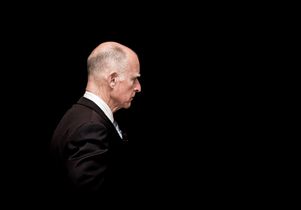
Professor Jon Christensen praises Gov. Jerry Brown for his deft ability to mix doomsaying predictions with pragmatic solutions as he strives to get Californians to mitigate the causes and effects of climate change.
All eyes are on Paris as the 2015 UN Climate Conference begins. California is well-represented, with many from the state participating, including five UCLA faculty and seven students.
From less electricity generated by coal to more whales in California, UCLA Institute of the Environment and Sustainability director Peter Kareiva offers things to be thankful for.
Eating local is good. All corporations are bad. Population growth is the problem. Peter Kareiva, director of the UCLA Institute of the Environment and Sustainability, implores people to question assertions like these.
Jon Christensen writes that to take these solutions from UC-wide to a global scale, we’ve got to start now using a combination of technology, outreach and policy.
UCLA environmental professors Magali Delmas and Susanna Hecht are among the climate experts, politicians and industry leaders gathering in San Diego today for a University of California climate change summit.
From Oct. 6 and running through Dec. 10, staff, faculty and students can join the challenge to reduce their carbon footprints and earn points for UCLA.
Cement manufacturing accounts for roughly 7 percent of the world’s carbon dioxide emissions, but scientists are determined to lessen its environmental impact.
A “Thinking L.A.” event, jointly sponsored by UCLA and Zocálo at the RAND Corporation Tuesday evening, explored the roots of the fervor surrounding fracking in California.
The Hammer and the UCLA Institute of the Environment and Sustainability present “The Next Wave: Quality, Quantity and Accessibility of Water in the 21st Century."
The models predict that the area burned by Santa Ana fires will increase by 64 percent and the are burned by non-Santa Ana fires will increase by 77 percent.
At a "Thinking L.A." event co-hosted by UCLA and Zócalo, four panelists discussed the importance and difficulty of implementing desalination plants, water-recycling facilities and other tools to help California make better use of its water resources.
The UCLA Center for World Health and the LA5 Rotary Club brought together a panel of experts to talk about the failing health of the Earth and what mega-cities can do about it before an audience of 200 business peoplein downtown Los Angeles.