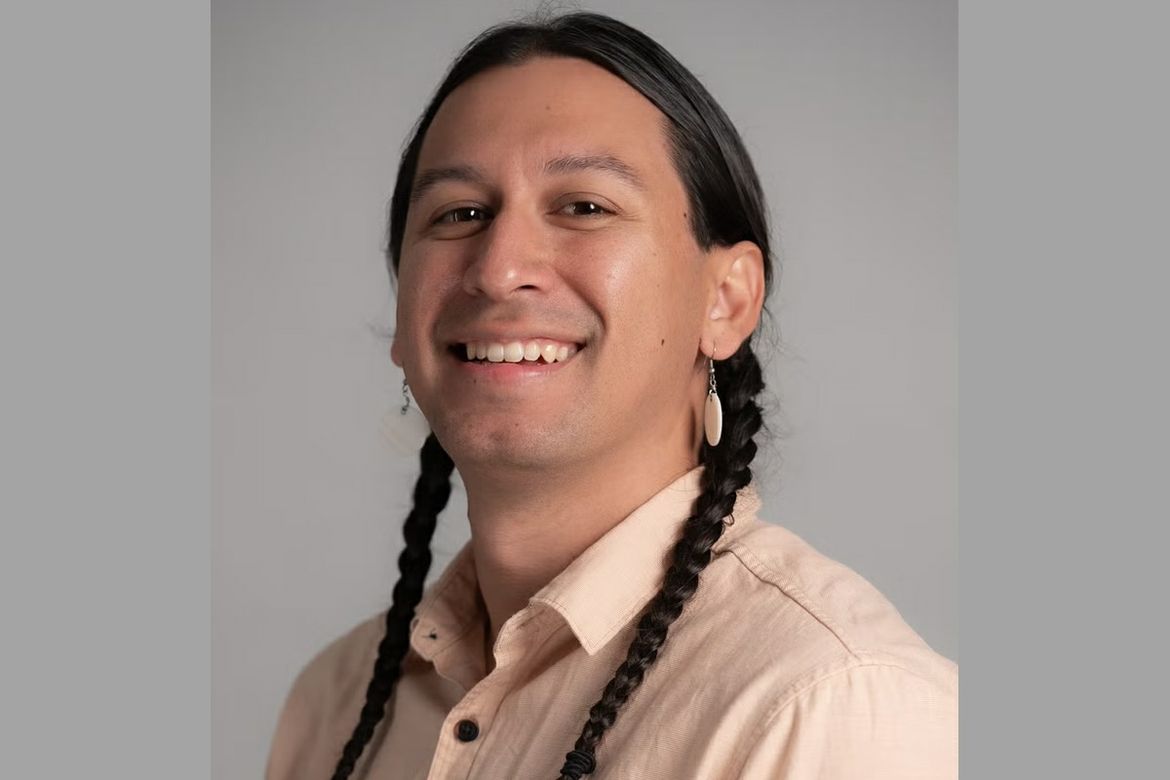
For Native American and Indigenous students at UCLA, a new campus center will offer opportunities to build community, connect with mentors, celebrate their cultures and find support throughout their college experience.
Launching this fall, the Native American and Indigenous Student Success Center, part of the American Indian Studies Center, is the result of years of collaboration among Native students, faculty and staff and a key focus of the chancellor's UCLA Native American and Pacific Islander Bruins Rising Initiative.
Leading this new effort is the center’s inaugural director, Joshua Thunder Little, who brings more than a decade of experience working with Native students and youth to the role, including helping to build the first Native Indigenous Resource Center at Pomona College. An enrolled member of the Oglala Lakota Nation who is also of Gabrielino/Tongva descent, Little has also worked extensively with UC Riverside’s Native American Student Programs, UCLA’s American Indian Recruitment Association summer program, Sherman Indian High School in Riverside and Upward Bound at the University of South Dakota.
Little, who grew up in Palm Springs, spoke with UCLA Newsroom about his vision for the center, the challenges Native students face and the methods of measuring student success.
What makes coming to UCLA especially meaningful for you?
There are several things that I’m excited about. The first one is working in Tovaangar. I am Tongva/Gabrielino and working at UCLA provides me the opportunity to live and work on my ancestral homelands. A full circle moment!
The Native American and Indigenous students on campus also excite me, as I am eager to learn from them. And Native and Indigenous staff and faculty at UCLA also provide me the professional and cultural workspace to join a learning environment and contribute to the work that has been done prior to starting my job.
Lastly, being able to work with a diverse institution and learn from peoples around the world is such a privilege. I hope to reciprocate that approach because it is my belief that all people can benefit from Indigenous knowledge systems.
What do you hope UCLA’s Native American and Indigenous Student Success Center will mean for students?
The Native American and Indigenous Student Success Center is a resource center at UCLA dedicated to supporting Native students through academic success, peer mentoring, student programming and wellness. It draws upon the framework of kuuyam (the Tongva/Gabrielino word for guest) to create a home for students on campus. Through its initiatives, the center will help students build skills such as collaboration, leadership and empathy.
Native students account for a small portion of UCLA's student body. What challenges can that create, and how can the campus community help address them?
Less than 1% of the student body at UCLA is Native, so they often feel isolated. As a former history major in my undergraduate and graduate studies, I always remind people to interrogate the historical record and learn why the Native population is so small. In fact, people should stop by my office in Campbell Hall — I would love to explain further the many challenges Native students face.
And I encourage members of the broader campus to be in community with Native and Indigenous students, to attend Native events and talk with us. Working with Indigenous peoples requires one to show up, engage in good relationships and understand the history of Native people.
Native students come to UCLA with the knowledge of their community and seek to learn skills to solve problems and prepare for a better future. To do this work, Native student programming needs funding. One of the best ways to meet the needs of Native students is to financially support the new center so students will have the opportunity to grow academically, professionally and culturally.
UCLA has a long history of Native student organizations and support programs. How will the new center build on that work?
Some of the Native Bruin groups on campus include student clubs such as the American Indian Student Association, the American Indian Science and Engineering Society, the American Indian Graduate Student Association and the Native American Law Students Association. Clubs like these have given undergraduate, graduate and law students spaces on campus to be in community.
In addition to the clubs, student-led recruitment and retention efforts have a foundational history at UCLA tracing back to the 1990s. The Native American and Indigenous Student Success Center seeks to strengthen those preexisting efforts and further ground them in the locality of Indigenous peoples through kuuyam.
Indigenous knowledge systems provide students the tools to be prepared to work in tribal communities and encourage them to look to the center of their traditions and learn their respective cultural teachings.
How will you know if the center is successful?
Measuring the success is very straightforward, but the path to get there can be complex because of how one needs to approach working with Indigenous communities. There is no one-size-fits-all solution to working with Native students, as each student faces unique challenges.
One of the measurements I intend to use is finding student joy. Are students enjoying their time? It may seem simple, but students are human first, and whether they are happy and enjoying their time in college is data I intend to collect.
Next, are they performing well academically, and are there opportunities to connect the theoretical concepts they learn in class to tribal communities? I also will be identifying what students are accomplishing as postgraduates. How are they using skills they learned in class and in extracurricular activities in the workforce?
Your commitment to Native education began long before your career in higher education. What first sparked that interest?
My pathway to becoming a higher education scholar and practitioner can be traced back to my experiences in middle school and high school. In my middle school history classes, I witnessed a lack of Indigenous perspectives in the curriculum. And in high school, I critiqued the curriculum that included Native people.
By the time I attended college at the University of California, Riverside, and worked as a student intern at the university’s Native American Student Programs, my passion only grew deeper, and I finally had the resources and support to do the work I was interested in.
At UC Riverside, I was given the space to connect the theory I learned in the classroom and put it into practice. For example, I took a class on California Indian history, and after that class I was working at Sherman Indian School with students in their classes. The skills I learned in that class helped me develop a pedagogy for Native students.
► UCLA's Native American and Indigenous Student Success Center is located in Room 3201 at Campbell Hall.