You’re not entirely sure what you’ve gotten yourself into.
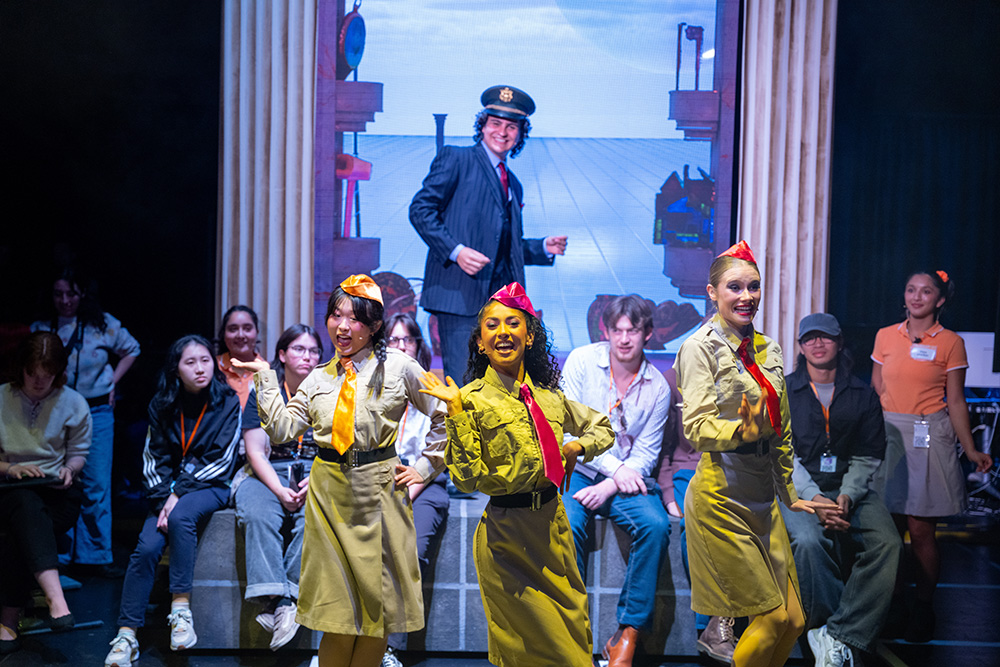
You’re sitting in Freud Playhouse, at the northeast corner of campus. In front of you, a row of imposing columns rises, larger than life. They close off the stage, beckoning you through a slim entrance into something ancient. All around you, enthusiastic young people glide through the space on Heelys, making their way toward you with the focused energy of people on a mission.
They are the acolytes, sent by the muses. And they are here to claim you.
The process that follows feels oddly familiar and decidedly less ethereal. Pick up a badge. Download an app. Find your group. It has the bureaucratic texture of conference registration, which is either deeply reassuring or faintly ominous, depending on your disposition. One of the acolytes leans in and tells you that before you can enter the performance space, you must make an offering to the muses.
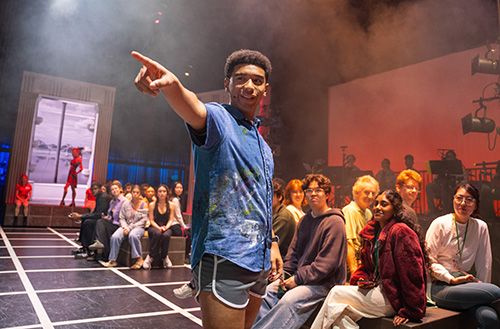
“Blow onto your phone screen,” they instruct.
Feeling more than a tad silly, you do it — because what else are you going to do? — and a tinkling of chimes emanates from your phone. The columns in front of you slowly part. You walk up the stairs and into the world of Xanadu — yes, that Xanadu — only this version is one reimagined by UCLA’s School of Theater, Film and Television into something the creators of the 1980 film could not have dreamed of. And it has nothing to do with the roller skates.
The original movie, a camp classic, featured the odd pairing of Olivia Newton-John and Gene Kelly and was built around the Electric Light Orchestra’s swooping, synthesizer-drenched songbook. The movie boasted the kind of tunes that are earnest and slightly absurd in equal measure, tunes that make you feel things you weren’t planning to feel. The ludicrous story follows Sonny (played by Michael Beck), a frustrated artist who is visited by Newton-John’s Kira, a Greek muse who takes human form to help him rediscover his creative fire (and, presumably, his love of roller disco). The 2007 Broadway musical iteration leaned into the camp, the spandex, the glorious and silly sincerity of it all.
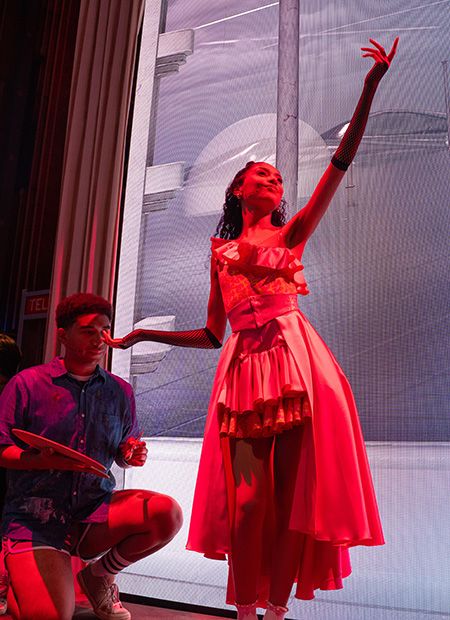
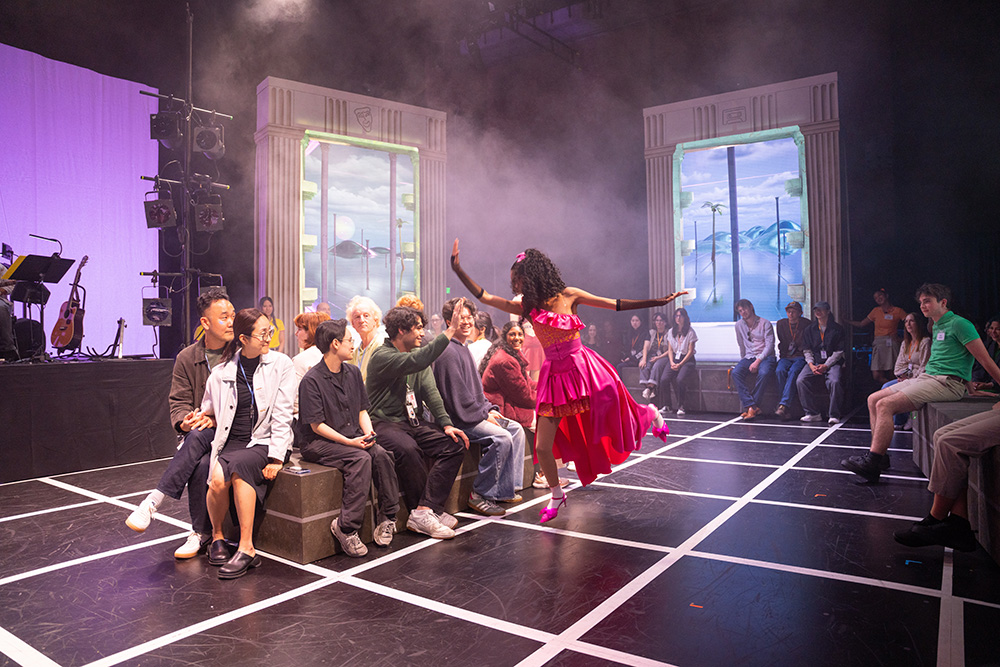
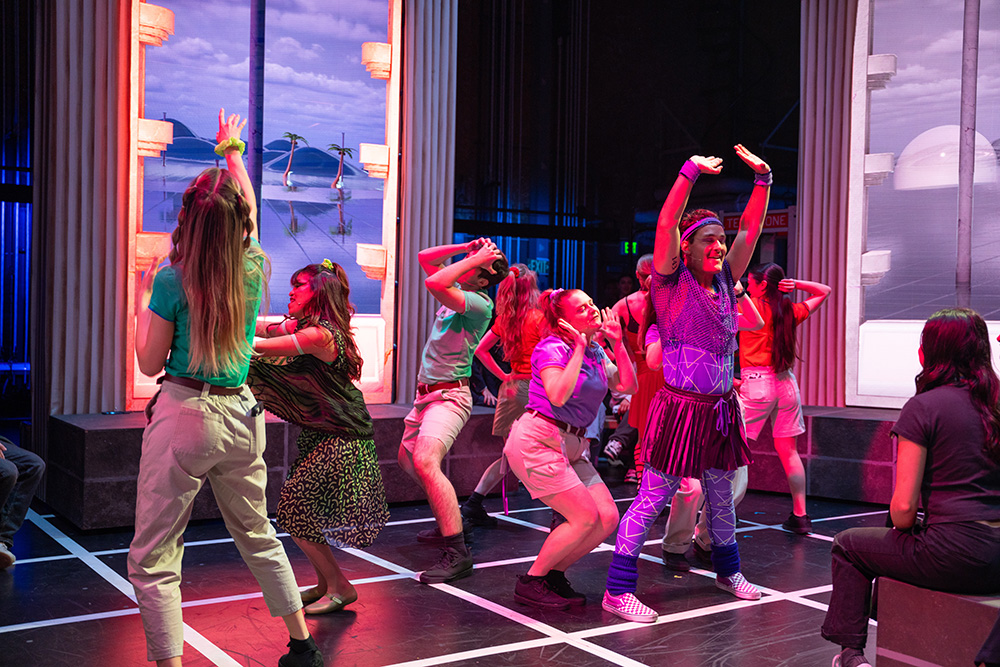
Now, walking past those majestic columns, you go and find your seat right on the stage. And soon enough, the story begins, introducing you to the nine muses of Greek mythology. You realize the columns actually contain LED screens. Arrayed across the stage, each serves as both platform and shrine. The stage becomes a vaporwave-soaked temple, candy-bright pinks and electric blues pulsing with a kind of digital spirituality that feels both ancient and absurdly contemporary.
And that phone still in your hand? It’s about to become something between a magic wand and a portal.
Welcome to the marriage of art and artificial intelligence. The UCLA production of Xanadu is, in some ways, the manifestation of something that has been bubbling up in the arts for the past several years. Ever since AI reared its (ugly or revolutionary, depending upon one’s perspective) head in the culture, the arts world has been trying to decide just what kind of portal or magic wand AI might wield. The debate has produced as much anxiety as it has answers. But as usual, UCLA has been ahead of the curve. For nearly two decades, TFT has been building, encouraging and inventing via REMAP, the Center for Research in Engineering, Media and Performance, a novel collaboration between TFT and the UCLA Samueli School of Engineering.
In that time, scores of innovative students, alums and faculty have worked together to bring to life entire worlds on stage, all using the latest technology. Xanadu is the most recent collaboration — and, to the layman’s eye, maybe the most cutting-edge to date.
But not quite, says Mira Winick ’20, dry and precise in the way of someone who has thought about a thing long enough to not need to be precious about it. A lecturer and graduate student at Arizona State University in Los Angeles, Winick co-directed Xanadu and now co-teaches alongside TFT theater department chair and associate dean of research and creative technology Jeff Burke ’99, M.S. ’01, M.F.A. ’10.
Swipe below to see more images from TFT's groundbreaking production of Xanadu:
“The technology is always a little behind what we imagine,” she says. “So part of the work is figuring out how to use what’s available to get as close as possible to the experience you want to create.”
Both TFT alums, Winick and Burke have been working together on REMAP projects for the better part of a decade. They’re from two different generations, connected by a technological shorthand and a shared audacity around what’s possible when it comes to live theater. They are convinced that there is opportunity here, at a top research institution, to think differently about what new technology can do in the arts. And how to put it through its paces.
“A lot of people are taking AI and applying it to an existing pipeline — using it to save money, speed things up,” Burke says. “We’re asking something different: What types of interactions weren’t possible until we had this technology? What can we enable in a genuinely new way?”
A bold new spin on crowdsourcing
We’re still early in the performance of Xanadu, and audience members have just been invited to use their phones as wands. Pointed at the shrine screens, they draw “gifts” to the muses. Well, “drawing” may be a generous term for the rough, Etch-A-Sketch approximations of birds and boomboxes that result from the audience’s efforts. It all feels a bit silly and awkward. The acolytes have become tech support.
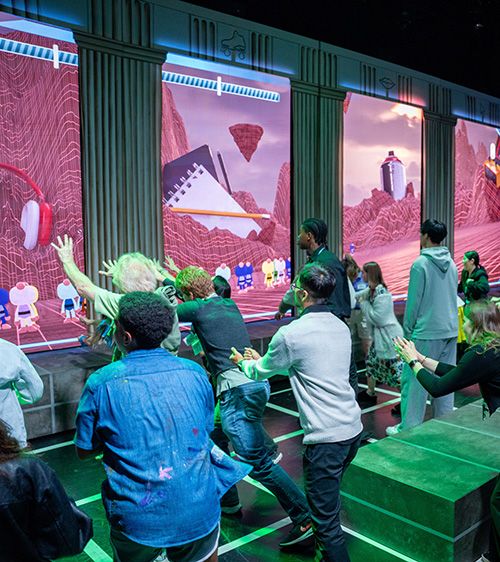
But the audience throws itself into the process, and within seconds, a generative AI pipeline built by Burke and the student team transforms the scrawls into fully rendered digital objects: vases, creatures, glowing artifacts, all in that insistent vaporwave palette. The objects drift along the screens for the rest of the show. The songs swell. The muses roller-skate past. Your terrible drawing of a microphone? It’s now a luminous artifact floating in a digital sky.
The students who built that system (many of whom, it should be noted, had never even heard of Xanadu before all of this) spent months learning to work across disciplines that don’t usually share a vocabulary, let alone a workflow.
Engineers work with live actors and musicians, actors learn to seamlessly translate a person-to-person performance into a camera blasting their digital visage 15 feet high, costume designers translate real fabric into a digital state. And visionary institutions embrace all of this as a freedom to explore and create.
This is the arts’ brave new world, and UCLA is facing it with not only courage, but also an unflappable belief that these are tools that can and should be harnessed for human creativity, not prompted to replace it.
“In the age of AI,” says Celine Parreñas Shimizu M.F.A. '96, the school’s powerhouse dean who returned to helm TFT at the beginning of the last academic year, “we center the unstoppable force of human authorship.”
\\\\\\\\\\\\\\\\\\\\\\\\\\\\\\\\\\
The stage becomes a vaporwave-soaked temple, candy-bright pinks and electric blues pulsing with a kind of digital spirituality. That phone in your hand is about to become something between a magic wand and a portal.
\\\\\\\\\\\\\\\\\\\\\\\\\\\\\\\\\\
Naisha Agarwal, a fourth-year computer science student, helped build the generative AI pipeline at the core of the sketch interaction. She describes balancing inputs from multiple directions: the rough sketch a user drew, a text description of that sketch, designer references for the vaporwave aesthetic, color palettes for each muse. Another student worked on the digital costume design, gathering fabric specifications for the AI-rendered costumes.
“We really wanted to play into the creativity that can happen with interpreting sketches with AI,” Agarwal says. “We were just actually willing to let it do whatever and then see what happens.”
Sometimes what happened was an octopus. Sometimes a row of toilets. The campy aesthetic of Xanadu is remarkably forgiving of generative chaos — which was kind of the point of choosing it, Winick says.
Later in the show, several performers become digital as they’re carried off to Mount Olympus. Their likenesses are mapped onto avatars inhabiting the shrine screens. But if you turn your head, you can see the actors right there, performing into their phones, live. Just a few feet away, they’re piloting their digital selves.
Winick calls it “rough magic,” a pragmatic embrace.
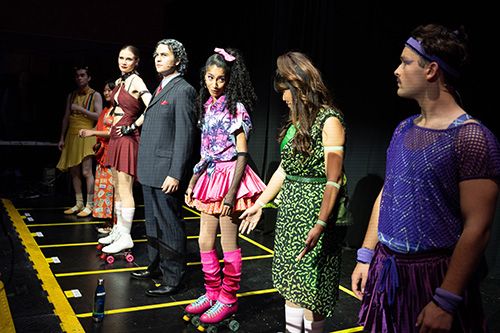
“You don’t have to hide everything and make it just an illusion,” she says. “Sometimes it’s more magical to see the people in action.”
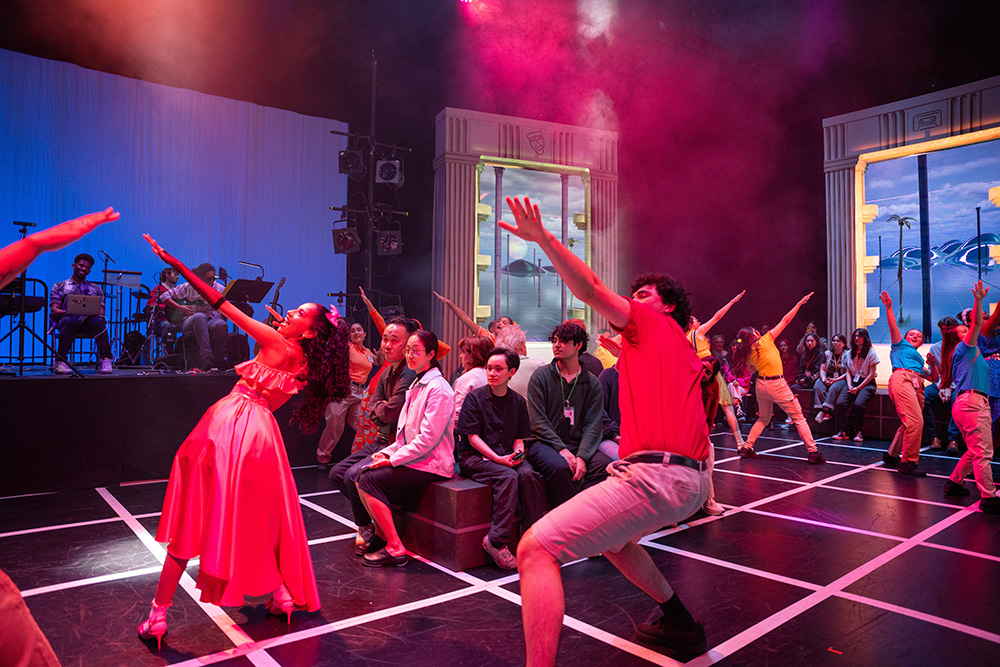
Her cast takes that idea seriously. At each performance, the muses and the acolytes rally their on-stage audience for a prolonged dance sequence, which is different every time thanks to AI-generated choreography derived from poses audience members had sketched earlier. Actors improvise Jazzercise-style instructions from moves that hadn’t existed an hour before.
The show is a whirlwind, performers spinning by on roller skates, acolytes gently guiding their novices around the stage to avoid collisions with the choreography of both the performers and the moving shrines, never breaking character. It’s the kind of theater that keeps you on your toes and fully present. And off your phone — except when the performance requires it.
Moving from “audiences” to “fans”
Built on the gaming platform Unreal Engine and supported by the Amazon MGM Studios Future Storytellers Initiative, Xanadu took nearly two years to go from early development to opening night. Nothing fully fixed. Nothing fully hidden. Every show its own. It was an exercise in weaving new technologies into an existing work. The course Burke and Winick are teaching starts from a different premise — and a different word.
Burke has been thinking about the distinction between an audience and a fan. An audience shows up, watches, and leaves. A fan has a relationship that extends beyond the moment. They want to know how something was made, who made it, the story behind the story.
“Moving from the term ‘audiences’ to ‘fans’ was intellectually really helpful,” Winick says. “With fans, you have this idea of a relationship that extends beyond the moment.”
TFT’s Emerging Technologies and Production Practice course is open to students across disciplines, from engineering to computer science to film. The most recent cohort, in Spring 2026, began working with “The Adept,” a storyline from Immortal Studios’ Wuxia-inspired storyverse. (Think about how tentpole comic book movies all play in the same universe.) The project carries particular resonance at UCLA: The studio was founded by Payhuan Shiao ’90, a UCLA alumnus whose father, beloved Wuxia author Shiao Yi, has his literary archive permanently housed at UCLA Library’s Richard C. Rudolph East Asian Library.
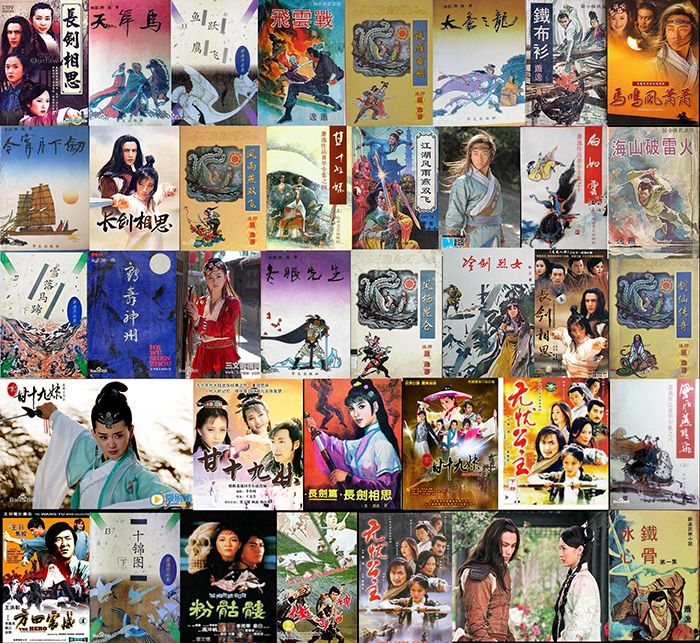
Much like the DC or Marvel universes, Wuxia is a genre of Chinese pop culture that spans film, television and graphic novels and follows the tales of wandering martial arts heroes. It’s fertile ground for building fan-centric experiences.
Students work in two teams. One team is developing an at-home experience in which fans train alongside “The Adept’s” heroine, Amy. Their movements are tracked by phone camera as they master the same martial arts she discovers in the story. The other team is designing a live concert experience around Sasha, a pop star in the Immortal universe, in which audience members upload personal objects that are then transformed — either purified or corrupted — as the concert’s narrative unfolds.
Both prototypes are early. Both have been play-tested, revised and play-tested again. Both will probably fail in interesting ways before they find their form. That is, more or less, the point. The course is supported by Qualcomm, whose investment centers on what becomes possible when AI runs locally on mobile devices — a distinction with real implications for how other interactive experiences can scale.
This summer, Burke is hosting a performance development workshop in which participants will begin writing an original musical theater work conceived specifically to harness this kind of interactive context. Unlike Xanadu, which came with IP that students and creators used as inspiration for the interactive elements, this time the story and systems are being designed, in parallel, from scratch. Burke and Winick are pretty firm on the idea that TFT’s next immersive theater experience will be set in a K-pop karaoke cabaret in the spirit world. Winick is cautious about how to best convey that afterlife setting to potential audiences. (Think Spirited Away, more than creepy horror, she says).
The vision is that the audience’s own dreams and imagination will once again be part of the performance. And they’ll already be fans of the music, with songs drawn from current K-pop hits. But what that will precisely look like when it finally hits TFT stages is still being invented, by waves of artists, engineers, performers and students working through the iterative, sometimes-failing, always-forward process that defines REMAP. And UCLA.
Read more from UCLA Magazine’s Summer 2026 issue.