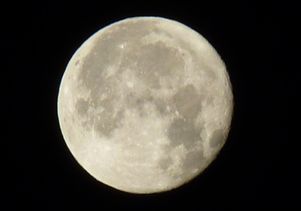
The moon does not influence the timing of human births or hospital admissions, a new UCLA study finds, confirming what scientists have known for decades.
Several new studies, one co-authored by a UCLA professor, show that transcription is in fact the most influential step in determining protein abundance.
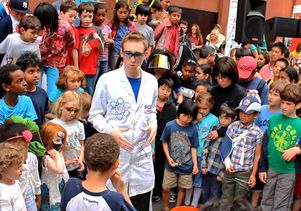
Biochemistry student Jeffrey Vinokur is the Dancing Scientist, whose zany science experiments have been featured on national TV shows, on YouTube and in school auditoriums.
Astronaut and three-time UCLA alumna Anna Lee Fisher addressed a roomful of students Monday at a UCLA Careers in Chemistry and Biochemistry to talk about her career and the lessons she learned while she attended UCLA.
Life scientists have created an accurate new method to identify markers for many diseases — a significant step toward a new era of personalized medicine, tailored to each person’s DNA and RNA.
Most of the laws of nature treat particles and antiparticles equally, but stars and planets are made of particles, or matter, and not antiparticles, or antimatter. That asymmetry puzzled scientists for many years.
Alan Rubin, the associate curator of the UCLA Meteorite Gallery and unofficial “cosmic killjoy,” regularly has to tell people the answer is no. But he'll also tell you where meteorites actually come from.
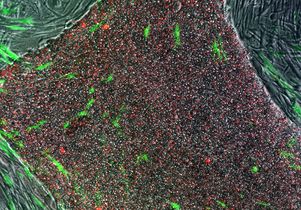
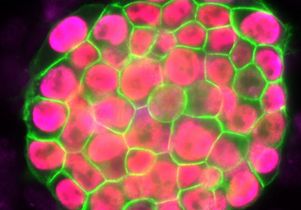
UCLA scientists say this could lead to a better understanding of stem cell signaling and the immune system response, paving the way for new and more effective therapies.
UCLA will host its free, annual “Exploring Your Universe” event — UCLA’s day for the public to learn about science — this Sunday, Nov. 16, from 12 noon until 5 p.m., with some activities continuing until 8 p.m., weather permitting.
The technique, developed by researchers from UCLA and the Department of Energy’s SLAC National Accelerator Laboratory, shows promise in powering the next generation of particle accelerators.
SACNAS at UCLA is trying to bring more Latinos and Native Americans into science and engineering, a crucial step to help the U.S. keep pace with the rest of the technological world.
The $2.3 million National Institutes of Health awards go to scientists from the Eli and Edythe Broad Center of Regenerative Medicine and Stem Cell Research at UCLA for work in stem cells and neuroscience in medicine.
Buffets of highly processed foods like sugar and flour are as tempting to rats as they are to humans and eating lots of this food weakens cues to stop eating when full.
Dozens of students from majors across campus have spent thousands of hours on building a loaf-of-bread-sized satellite that will measure space weather.
The public is invited to join world-renowned culinary visionaries at UCLA's popular "Scientific Bake-off," part of life scientist Amy Rowat's "Science and Food" course.
Amy Rowat, an assistant professor in UCLA's Department of Integrative Biology and Physiology, believes food can be a powerful way to communicate science to a broad audience.
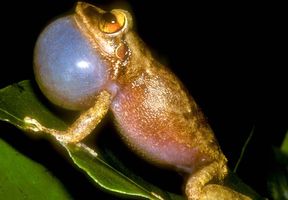
UCLA scientists found that not only have male coquis become smaller, but their mating call has also become shorter and higher pitched; the researchers attribute the change to Puerto Rico's warmer temperatures.