Scientists had assumed the core was rotating at about the same speed as the surface, but this surprising observation might reveal what the sun was like when it formed.
UCLA Ph.D. student Andy Tay writes about a crucial a challenge to long-distance space travel — overcoming the long-term effects of microgravity on our bodies.
An international team of astronomers has observed a striking spiral pattern in the gas surrounding a red giant star called LL Pegasi and its companion star 3,400 light-years from Earth.
A “baby” solar system 300 light-years away has given astrophysicists from UCLA and the Carnegie Institution for Science a rare peek at the formation of a planet.
A UCLA-led team of scientists discovered a white dwarf star in the constellation Boötes whose atmosphere is rich in carbon, nitrogen, oxygen and hydrogen.
UCLA’s Jonathan Aurnou and collaborators in Marseille, France, demonstrated that the planet’s jets likely extend thousands of miles below its visible atmosphere.
A UCLA-led research team reports that the moon is at least 4.51 billion years old and probably formed only about 60 million years after the birth of the solar system — 40 million to 140 million years earlier than had been thought.
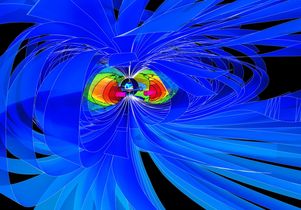
New findings by a UCLA-led team of researchers answer a question about our space environment and will help scientists protect telecommunication and navigation satellites.
Kepler-62f could have atmospheric compositions that allow it to be warm enough to have surface liquid water, which would make it possible for the planet to support life.
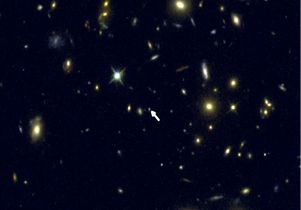
The researchers made the discovery using an effect called gravitational lensing to see the incredibly faint object, which was born just after the Big Bang.
The August 2017 expedition to Swan Valley Idaho is presented by UCLA Alumni Travel, which was launched 75 years ago for sojourners who share a passion for learning.
The award is given annually 'for the greatest achievement in aeronautics or astronautics in America, with respect to improving the performance, efficiency, and safety of air or space vehicles.'
The violent impact with a “planetary embryo” called Theia occurred approximately 100 million years after the Earth formed, UCLA geochemists and colleagues report.
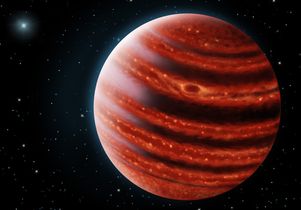
A planet 100 light-years away that resembles a young Jupiter has been discovered by an international team of astronomers that includes six UCLA scientists.
Glen MacDonald, UCLA’s John Muir Memorial Endowed Chair in Geography, and Laurence C. Smith, professor and chair of the UCLA Department of Geography, have been elected to the Class of 2015 Fellows of the American Geophysical Union.