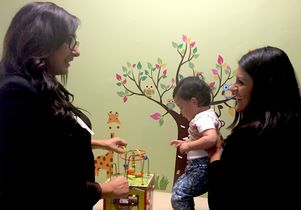
The new model seeks to improve upon the traditional appointment, which often doesn’t leave enough time to discuss parenting issues and child behavior and development.
Scientists have pinpointed two tiny clusters of neurons that are responsible for transforming normal breaths into sighs, which could one day allow physicians to treat patients who cannot breathe deeply on their own.
The study found that close to half of Americans who are considered overweight by virtue of their BMIs — 34.4 million people — are healthy, as are 19.8 million who are considered obese.
Two UCLA experts on end-of-life issues talk about California’s new physician-assisted suicide law that will give terminally ill patients and their doctors a legally sanctioned process to talk about difficult choices.
Study of more than 7,000 students in 77 elementary schools found that one program greatly benefited the mental health of sixth-graders who experienced the most bullying.
BPS, a common replacement for BPA in plastics, has also been linked to health risks. New UCLA-led research demonstrates some of the mechanisms that make BPS just as harmful.
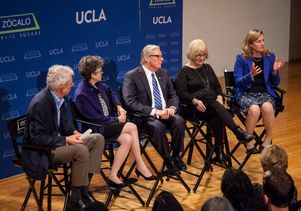
An expert discussion jointly sponsored by UCLA and Zocálo, explored the ethical challenges around death that arise in an age of tremendous advances in medical treatment.
Post-acute care accounts for some $62 billion in annual Medicare spending, but spending varies widely across different parts of the U.S., suggesting that some medical centers may be using these services too often.
Johnese Spisso, a nationally recognized academic health care leader, will oversee all operations of UCLA’s hospitals and clinics as well as the health system’s regional outreach strategy, effective Feb. 8.
Through a systematic review of Alzheimer’s studies, Ron Brookmeyer’s team at UCLA has found that the rate of being diagnosed with the disease doubles every five years in older populations.
The founding director of UCLA’s Ahmanson-Lovelace Brain Mapping Center is now vice chancellor for UCLA Health Sciences and chief executive officer of UCLA Health. And he’s still in awe of the brain and its complicated choreography.