UCLA’s Jonathan Aurnou and collaborators in Marseille, France, demonstrated that the planet’s jets likely extend thousands of miles below its visible atmosphere.
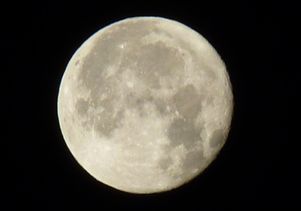
A UCLA-led research team reports that the moon is at least 4.51 billion years old and probably formed only about 60 million years after the birth of the solar system — 40 million to 140 million years earlier than had been thought.
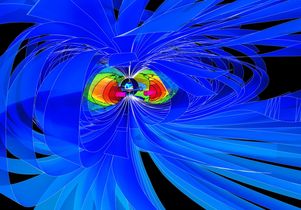
New findings by a UCLA-led team of researchers answer a question about our space environment and will help scientists protect telecommunication and navigation satellites.
Kepler-62f could have atmospheric compositions that allow it to be warm enough to have surface liquid water, which would make it possible for the planet to support life.
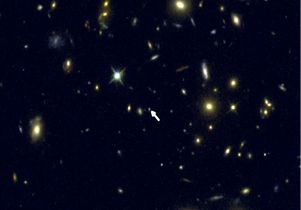
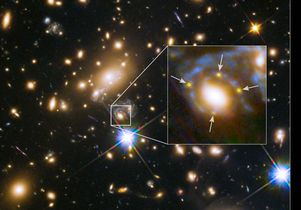
The researchers made the discovery using an effect called gravitational lensing to see the incredibly faint object, which was born just after the Big Bang.
The violent impact with a “planetary embryo” called Theia occurred approximately 100 million years after the Earth formed, UCLA geochemists and colleagues report.
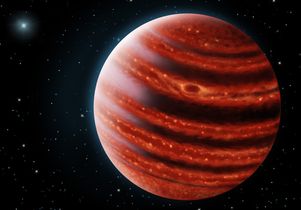
A planet 100 light-years away that resembles a young Jupiter has been discovered by an international team of astronomers that includes six UCLA scientists.
NASA’s Dawn mission is observing the dwarf planet Ceres from 2,700 miles above its surface; the space agency has released new images and a video animation.
The moon does not influence the timing of human births or hospital admissions, a new UCLA study finds, confirming what scientists have known for decades.
Astronaut and three-time UCLA alumna Anna Lee Fisher addressed a roomful of students Monday at a UCLA Careers in Chemistry and Biochemistry to talk about her career and the lessons she learned while she attended UCLA.
Most of the laws of nature treat particles and antiparticles equally, but stars and planets are made of particles, or matter, and not antiparticles, or antimatter. That asymmetry puzzled scientists for many years.
Alan Rubin, the associate curator of the UCLA Meteorite Gallery and unofficial “cosmic killjoy,” regularly has to tell people the answer is no. But he'll also tell you where meteorites actually come from.