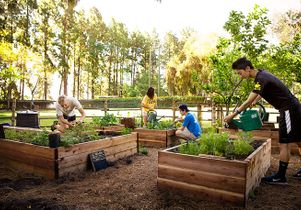
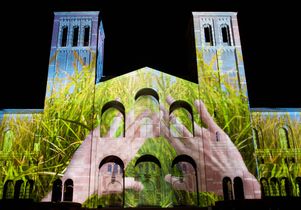
UCLA Residential Life’s Sustainable Living Community and the Education for Sustainable Living Program at UCLA have won awards given to honor innovation at UC and CSU campuses.
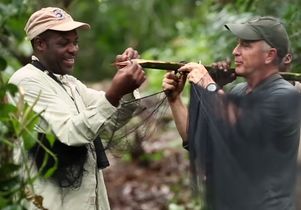
The Congo Basin Institute in Cameroon will provide a one-of-a-kind center to address the challenges of food and water security, climate change, biodiversity loss, public health and emerging diseases.
Glen MacDonald writes that rising temperatures, groundwater depletion and a shrinking Colorado River mean the most populous U.S. state will face decades of water shortages and must adapt.
Jon Christensen writes that artist Michael Heizer’s monumental sculpture called “City” best embodies the Western ethos of humanity’s role shaping and adapting to the vast open expanse.
UCLA faculty, staff and students, with guidance from a Santa Monica architect, are building a prototype dwelling that they designed to shelter people as well as edible plants, bees, birds, lizards and even bats.
The new artificial turf on the intramural field and other places combined with drought-tolerant landscaping from five large projects, could save 11.3 million gallons annually.
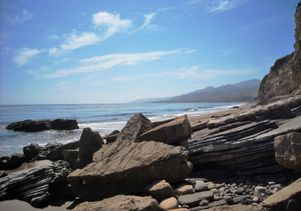
A new report from UCLA School of Law’s Emmett Institute on Climate Change and the Environment provides recommendations on how to harness AB 2516 to enhance coastal climate change preparedness in California.
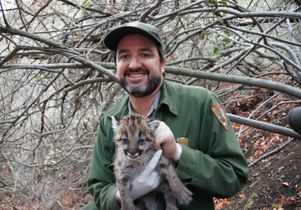
When the Griffith Park mountain lion crawls under someone’s house, or a brother and sister cross a freeway, Seth Riley is at the top of the list of scientists who can give the inside details.
UCLA has been recognized in three categories of the 2015 Energy Efficiency and Sustainability Best Practice Awards Competition from the California Higher Education Sustainability Conference.
Despite progress, dirty air and water are just the beginning of the region's environmental troubles. The findings, which are believed to be the most comprehensive environmental report card for any region in the nation, show the county needs tutoring to bring up its grades.
UCLA researchers looked at 22 indicators to determine grades in six main categories — water, air, ecosystem health, waste, environmental quality of life, and energy and greenhouse gases.
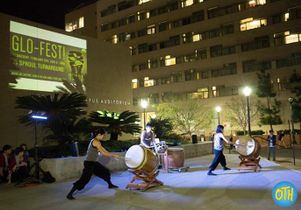
UCLA students are going dark for Earth Hour on March 28, by turning off the lights free for an hour to join the international event raising awareness about climate change and energy usage.
After nearly a month of turning off the lights, doing laundry with cold water and taking the stairs instead of the elevator, UCLA students are currently a close second in a competition among residence halls to see which UC campus can save the most energy.
California could better coordinate transportation spending to support improved maintenance of existing roads and improved public access to walking, biking and transit infrastructure.
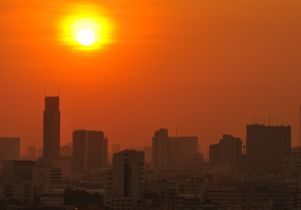
The number of cities across the globe that experience heat waves has increased since the 1970s — as has the frequency of those heat waves — as the heat island effect amplifies global warming.
A team of life scientists has found part of the answer: The amount and intensity of striping in different zebra populations can be best predicted by temperature.
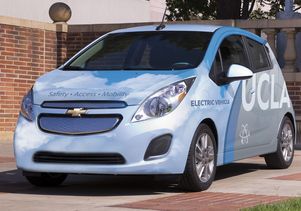
UCLA Transportation’s focus on alternative transportation and success in reducing traffic and emissions at UCLA won an award from the California Environmental Protection Agency
As the UC system marches toward its goal of carbon neutrality by 2025, UCLA is doing its part by using less energy in buildings, converting half of its fleet to alternative-fuel vehicles and adding LEED-certified green buildings.
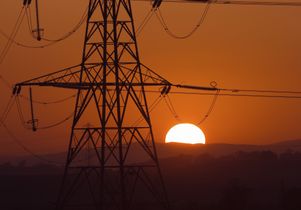
Expanding customer access to energy data can bring cleaner, more efficient power to Californians, save money and boost emerging clean technologies, according to a new report by the Climate Change and Business Research Initiative, a partnership between UCLA and UC Berkeley schools of law.
The scientists resolved a dispute over whether a small population of black-headed squirrel monkeys, which are found only in an isolated part of Brazil, is a sub-species of another species or its own species.
People told how much cancer-causing pollution they could prevent were more likely to change their power usage than people told how much money they could save.
The year 2014 featured the debut of a multi-year fundraising campaign, research breakthroughs, stunning achievements by students and faculty — and an unexpected flood that impacted the campus for months. We call that a momentous year.